- Car
- Massey-Ferguson (0 offers)
Buy Massey Ferguson Classic Tractors
From the "Little Grey Fergie" TE20 to the record-breaking 100 Series, Massey Ferguson built the tractors that defined British farming. Coventry-built machines with Perkins diesels, Ferguson hydraulics, and a collector scene that leads the vintage tractor world.
Search results
Currently, there are no matching listings for your search.
Create search alert
Let yourself be notified as soon as a listing is published that matches your search filters.
Create listing
Do you have a Massey-Ferguson that you want to sell? Then create a listing now.
Create listingMassey-Ferguson listing references from Classic Trader
Below you will find listings related to your search that are no longer available on Classic Trader. Use this information to gain insight into availability, value trends, and current pricing for a "Massey-Ferguson" to make a more informed purchasing decision.
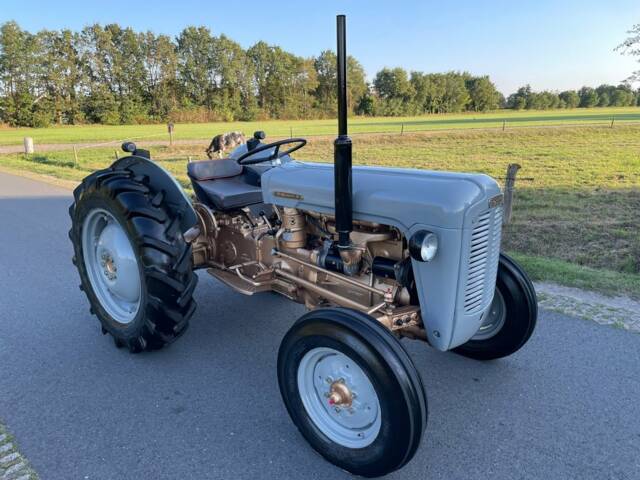
1957 | Massey-Ferguson MF 35
Massey Ferguson FE35 "Gold Belly" Tractor | 1957 | Route 66 Auctions - For sale by auction. Estimate 16200 EUR

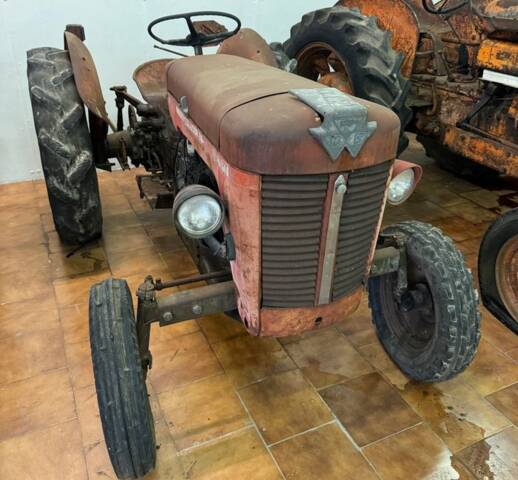
1964 | Massey-Ferguson MF 35
Trattore Massey Ferguson - Type 30_8 - NO RESERVE - 1964
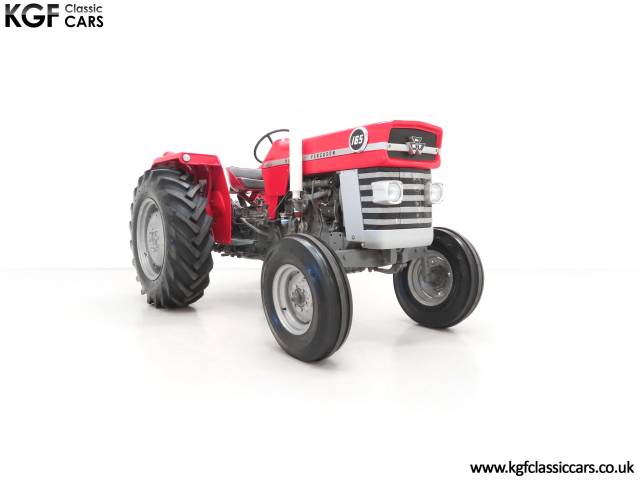
1971 | Massey-Ferguson MF 165
A Fully Restored and Fully Functioning Massey Ferguson MF165 in Wonderful Cond

Create search alert
Let yourself be notified as soon as a listing is published that matches your search filters.
Create listing
Do you have a Massey-Ferguson that you want to sell? Then create a listing now.
Create listingHistory & Heritage
The story of Massey Ferguson begins with two parallel threads that converged in 1953 to create one of the most important names in agricultural machinery.
In Canada, Daniel Massey founded the Newcastle Foundry and Machine Manufactory in 1847. By 1891, after merging with competitor A. Harris, Son & Co., Massey-Harris had become the largest agricultural equipment manufacturer in the British Empire. The company pioneered harvesting technology and became one of Canada's first multinational corporations.
In Northern Ireland, engineer Harry Ferguson was developing what would become the single most important innovation in tractor history: the three-point hydraulic linkage with automatic draft control. Patented in 1925 as the Ferguson Master Patent, this system allowed tractor and implement to function as a single unit — a principle that every modern tractor still uses today. After a partnership with Henry Ford (the Ford-Ferguson 9N, 1938–1947) ended in acrimony, Ferguson established his own company and, in 1946, launched the Ferguson TE20 — the legendary "Little Grey Fergie".
The TE20 was built under contract by the Standard Motor Company at their Banner Lane factory in Coventry, England — a former wartime shadow factory that had previously produced Bristol Hercules aero engines. By the time production ended in 1956, over 500,000 TE20 tractors had rolled off the Coventry production line.
In August 1953, Ferguson merged his company with Massey-Harris to form Massey-Harris-Ferguson Ltd. The name was shortened to Massey Ferguson in 1958, and in 1959 the company acquired both Perkins Engines of Peterborough and full ownership of the Banner Lane factory from Standard. This dual acquisition would define Massey Ferguson's product line for decades: Perkins diesels under Coventry-built chassis became the formula for success.
The 100 Series — marketed as "The Red Giants" — launched at the 1964 Smithfield Show in London and transformed the tractor market. The MF 135, MF 165, and MF 175 became instant bestsellers. The MF 135 alone accounted for 22% of the UK tractor market in 1967 and 56% of the global market in the 43–52 hp sector. Between 1964 and 1979, 413,153 MF 135s were built at Coventry.
After financial difficulties in the 1980s and several ownership changes, Massey Ferguson was acquired by American AGCO Corporation in 1994. The Banner Lane factory closed on Christmas Eve 2002, with the last tractor — number 3,307,996 — completing a production run that had begun with the TE20 in 1946. Manufacturing moved to Beauvais, France, where Massey Ferguson tractors continue to be built today.
Highlights & Features
What makes Massey Ferguson the most collected tractor marque in Britain — and arguably the world — comes down to three factors: historical significance, mechanical simplicity, and unrivalled parts availability.
The Ferguson System: Harry Ferguson's hydraulic three-point hitch with automatic draft control was the technological foundation that made the marque. Every modern tractor uses a version of this system. Owning a classic Massey Ferguson means owning a piece of engineering history that shaped global agriculture.
Perkins Diesel Engines: The Perkins engines fitted from 1959 onwards — particularly the AD3.152 (3-cylinder, 2.5-litre) in the MF 135 and the AD4.203 (4-cylinder, 3.3-litre) in the MF 165 — are renowned for their durability. Their straightforward construction allows repairs that even amateur mechanics can undertake. Many Perkins-powered MF tractors are still working after 50+ years with minimal intervention.
Massive Production Numbers: Over 500,000 TE20s, over 413,000 MF 135s, and hundreds of thousands of MF 165s and MF 175s — these volumes ensure that examples remain plentiful and parts supply is among the best in the entire vintage tractor sector. Specialists like Anglo Agriparts, Tractor Spare Parts Ltd, and countless UK-based suppliers stock virtually every component.
Britain's Home Marque: Massey Ferguson tractors were designed and built in Coventry. For British collectors, these are home-grown machines — built in the same city as Jaguar, Rover, and the British motor industry. The Ferguson Club, vintage tractor rallies, ploughing matches, and the thriving show scene make Massey Ferguson the social heart of British vintage tractor culture.
Technical Data
Multi-Power Transmission: The optional powershift gearbox doubled the ratios (from 6 to 12 forward and 2 to 4 reverse gears) and allowed gear changes under load via a hydraulic clutch. Multi-Power models command a premium among collectors and are noticeably more usable in the field.
Market Overview & Buying Tips
The market for classic Massey Ferguson tractors is the most active and accessible in the entire vintage tractor sector. Britain is the marque's home market, and the collector infrastructure — auctions, parts suppliers, clubs, and shows — is unmatched anywhere in the world.
Price Guide by Model (2024–2026)
Ferguson TE20 "Little Grey Fergie":
- Project/renovation: £1,500–3,000
- Good working condition: £3,500–6,000
- Fully restored/show quality: £7,000–15,000
- Rare variants (TE-F 20 Diesel, Industrial): £5,000–10,000+
- Auction highlight: A Ferguson TE20 with Perkins P3 engine and Selene 4WD conversion achieved £26,000 at H J Pugh (February 2026, Mourne Collection sale).
MF 35 / FE 35:
- Project: £1,500–2,500
- Good condition: £3,500–6,000
- Restored/show quality: £8,000–15,000
- Rare FE 35 Industrial: A restored example achieved £33,000 at H J Pugh (February 2026).
MF 135:
- Project/tired runner: £2,000–3,500
- Good working condition: £4,000–8,000
- Multi-Power variant: add £500–1,500
- Restored/show quality: £12,000–25,000
- Auction highlight: A 1971 MF 135 in immaculate condition (restored 2012) achieved £25,000 at Cheffins (October 2025). A 1966 MF 135 (LYA627E), single family ownership, sold for £8,500 at Cheffins (July 2025).
MF 165:
- Working condition: £3,500–7,000
- Good to very good: £7,000–15,000
- 4WD variant (165S Allrad): £10,000–18,000
MF 175 / 178 / 185 / 188:
- MF 175: £4,000–10,000
- MF 178: £7,000–15,000
- MF 188 Multi-Power, original condition, low hours: A 1973 example with just 1,102 hours on original Goodyear tyres achieved £32,000 at Cheffins (October 2025).
Rare & Collectible Models:
- MF 1250 (articulated tractor): The pinnacle of MF collecting. A 1981 example with 2,774 hours achieved £61,000 at Cheffins (October 2025). A 1982 MF 1250 reached £70,000 at Cheffins (May 2022, Alan Bancroft sale).
- MF 2725 (4WD, rare): A 1985 example in original condition with 2,782 hours achieved £41,500 at Cheffins (March 2024).
- MF 390T: Low-hour originals command strong prices — a 2WD example with 3,402 hours sold for £21,000 + VAT at Cheffins (July 2025).
What to Inspect Before Buying
Engine: Cold-start the Perkins diesel. Excessive blue smoke indicates worn piston rings or valve guides; black smoke points to injector or fuel pump issues. A compression test reveals internal condition. Check under the oil filler cap for sludge — a sign of poor maintenance.
Hydraulics: Test the three-point hitch under load. Slow lifting or drifting down indicates worn pumps or seals. Check hydraulic fluid for cleanliness and correct level — milky or foamy fluid indicates water contamination.
Transmission & Clutch: Shift through all gears with the engine running. Grinding or difficulty engaging suggests clutch wear or synchro damage. On Multi-Power models, check that the powershift engages cleanly.
Steering & Brakes: Check tie rods and drag link for play. Test brakes individually and together — uneven response could indicate worn linings or linkage issues. On tractors with a shared oil system, worn brake material entering the hydraulic/transmission oil is a serious and costly problem.
Rust & Frame Integrity: Inspect the rear axle housing, front bolster, seat pan, and fuel tank for corrosion. The fuel tank sits above the gearbox — leaking tank seals can allow fuel to contaminate the transmission oil, causing expensive damage.
Tyres: Tyre condition can account for up to a third of a tractor's value. Check for cracks, bulges, and uneven wear. Inspect rims for weld repairs, particularly around valve stems and bolt holes.
Documentation: Match the serial number to registration documents. Service records and receipts add value and confidence.
Parts Availability
The parts situation for classic Massey Ferguson tractors is outstanding. UK-based specialists including Anglo Agriparts, Brockhills, and numerous independent suppliers carry comprehensive stocks of new, reconditioned, and pattern parts. For the TE20, MF 35, MF 135, and MF 165, virtually every component is available — from engine and gearbox internals to hydraulic components, bodywork, and electrical parts.
Driving Feel
Climbing aboard a Ferguson TE20 for the first time is a revelation in compactness. At just 750 kg and barely a metre wide, the "Little Grey Fergie" feels almost delicate — yet this is precisely what made it so beloved on small farms and in tight yards. The Standard four-cylinder engine chatters with character, and the unsynchronised 3-speed gearbox demands deliberate, confident gear changes. The steering is direct but unassisted — at low speeds, it requires genuine effort.
The MF 135 is the tractor most people picture when they think of Massey Ferguson. The Perkins three-cylinder diesel fires with its distinctive, rhythmic clatter and runs with a smoothness remarkable for a 3-cylinder engine. The 45 hp is more than adequate for most farm and yard work. The Multi-Power transmission allows gear changes under load — a tangible comfort gain during long days in the field. The Ferguson hydraulics respond precisely and powerfully; lifting heavy implements is effortless.
The MF 165 delivers a noticeably more assured driving experience with its four-cylinder Perkins. The additional 13 hp and greater torque make a real difference when pulling heavy cultivation equipment. The 4WD variant transforms the 165 into a genuine all-rounder — on wet ground and slopes, the engageable front-wheel drive provides decisive traction advantages.
The MF 175 and its successors, the 178 and 188, represent the upper echelon of the 100 Series. With 66 to 83 hp from the robust Perkins A4.236 and A4.248 engines, these tractors pull heavy ploughs and cultivators without strain. The driving experience is distinctly more "grown-up" — more mass, more power, more presence in the field.
What unites all classic Massey Ferguson tractors is the immediate, honest driving feel: no onboard computer filters the feedback, no electronics correct the driver. You feel the ground, hear the engine working, and after an hour you know exactly what the tractor has accomplished.
Design & Coachwork
The design of Massey Ferguson tractors reflects the era of their creation — and is always subordinate to function.
The Ferguson TE20 (1946–1956) is defined by its reduced, almost elegant form. The light grey livery (hence "Little Grey Fergie"), narrow bonnet, free-standing mudguards, and open driving position give it a timeless simplicity. The design was relentlessly focused on lightness and visibility — the driver needed to see all hitch points at a glance.
The MF 35 (1956) introduced the grey-and-red colour scheme that remains Massey Ferguson's trademark to this day. The rounded mudguards and slightly fuller bodywork signalled the step into a new performance class.
The 100 Series (from 1964) brought the angular, modern design that made Massey Ferguson instantly recognisable worldwide. The squared-off bonnet, flat mudguards, and clear separation between engine compartment and driving position defined the image of the modern tractor. From 1965, the bodywork became even more angular, and from 1971 the enlarged fuel tank raised the radiator grille and lengthened the steering column. The straight box-section front axle replaced the swept-back axle of early models — a detail by which connoisseurs can identify the year of manufacture at a glance.
Later 100 Series models (MF 148, 168, 188) received "luxury" features including safety cabs (from Sirocco, Cabcraft, and others) that significantly altered the appearance and made the tractors all-weather capable.
Other
Harry Ferguson — The Inventor: Harry Ferguson (1884–1960) was one of the most influential engineers in agricultural history. Born in County Down, Northern Ireland, he developed not only the three-point hydraulic system but was also a keen racing driver and aviation pioneer — he was the first Irishman to build and fly his own aircraft (1909). His 1925 patents form the basis of tractor-implement coupling to this day.
Banner Lane, Coventry: The legendary factory where over 3.3 million tractors were built no longer exists. The site was redeveloped for housing after closure in 2002. The famous tower block, opened in 1966 and a landmark of tractor production, was demolished. For collectors, a tractor with Coventry provenance remains a special piece of British industrial heritage.
The Collector Scene: Massey Ferguson dominates the vintage tractor scene in Britain and Ireland. According to FTMTA statistics, the MF 135 remained the most frequently registered vintage tractor in Ireland in 2024 — followed by the MF 35 and Ferguson TE20. The Ferguson Club organises regular meetings, exhibitions, and outings across the UK. Major auction houses like Cheffins (Cambridgeshire) and H J Pugh (Herefordshire) hold dedicated vintage tractor sales where Massey Ferguson tractors consistently achieve the highest prices.
The Mourne Collection Sale (2026): One of the most significant Ferguson/Massey Ferguson collections ever assembled — over 120 tractors from a County Down collector — was sold by H J Pugh in February 2026, with the restored MF 35 Industrial topping the sale at £56,000 and a Ferguson Brown Type-A achieving £24,000.
Summary
Massey Ferguson stands for the democratisation of agriculture like no other marque. From the revolutionary Ferguson TE20, which gave small farms access to mechanisation, to the million-selling MF 135, to the powerful MF 188 — each of these tractors tells a chapter of farming history.
For collectors and newcomers alike, Massey Ferguson is the ideal marque: the engineering is simple and robust, parts supply is exemplary, and prices remain moderate compared to classic cars. A running MF 135 can be had from around £4,000, a restored TE20 from about £7,000. Rare models like the MF 1250 articulated tractor or early Ferguson Industrial variants reach five-figure sums at auction.
Whether as a show piece at a vintage rally, a working machine on a smallholding, or an investment in living engineering history — a classic Massey Ferguson is a decision you rarely regret. These are the tractors that built modern Britain, and they remain as honest, capable, and rewarding today as when they first left Banner Lane.