- Car
- Volkswagen
- Volkswagen Golf
- Volkswagen Typ 17 (5 offers)
Volkswagen Golf Typ 17 classic cars for sale
The Volkswagen Golf Typ 17 is the first-generation Golf, introduced in 1974 as Volkswagen’s front-wheel-drive, water-cooled successor to the Beetle. The range spans austere 1.1-litre hatchbacks, well-equipped GLS versions, diesel and GTD models, the Karmann-built Cabriolet and the injection-fed Golf GTI.
Search results


1983 | Volkswagen Golf Mk I GTI Pirelli 1.8
Volkswagen Golf GTI / Pirelli / Rennwagen

Auctions ending soon

Loading…
Loading…
Loading…
Loading…
1983 | Volkswagen Golf Mk I 1.5
Volkswagen Golf 1 GTI 1.8

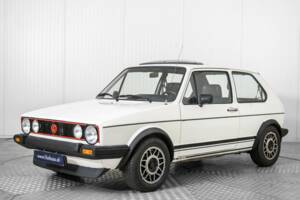
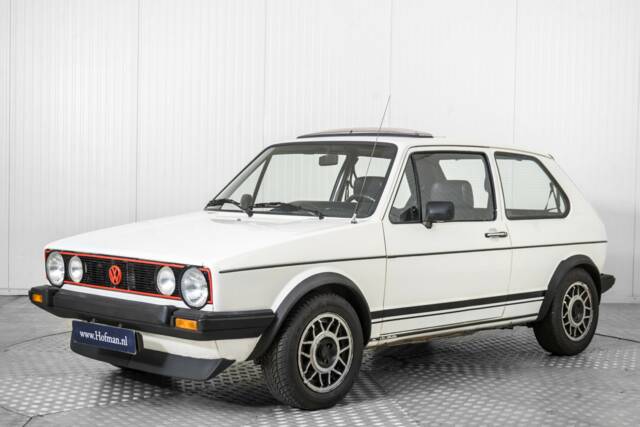
1983 | Volkswagen Golf Mk I GTI 1.8
Volkswagen Golf 1 1.8 GTi
Newsletter
The best Volkswagen listings, straight to your inbox
Get hand-picked Volkswagen listings, plus the best of cars, motorbikes, and auctions on Classic Trader — all in one place.


1982 | Volkswagen Golf Mk I 1.5
Volkswagen Golf 1 1.6D CL Diesel uniek slechts 100.000 km
Volkswagen Golf Typ 17 listing references from Classic Trader
Below you will find listings related to your search that are no longer available on Classic Trader. Use this information to gain insight into availability, value trends, and current pricing for a "Volkswagen Golf Typ 17" to make a more informed purchasing decision.
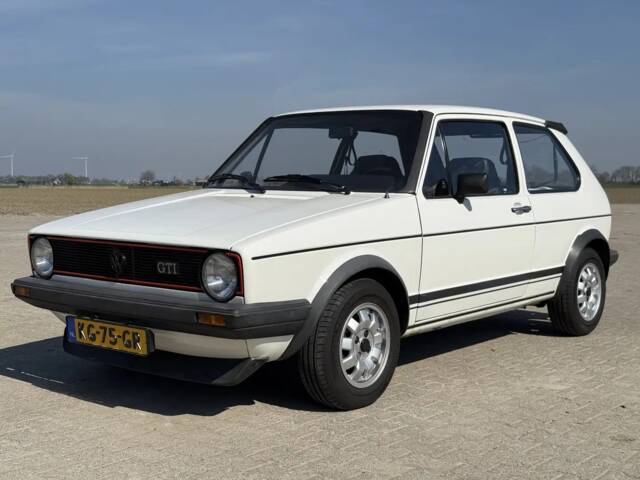
1983 | Volkswagen Golf Mk I GTI 1.8
Original Volkswagen GTI Rabbit

1980 | Volkswagen Golf Mk I GTI 1.6
Rare & Early Mk1 GTI | Outstanding Condition


1980 | Volkswagen Golf Mk I GTI 1.6
Originally delivered in Italy, second owner, and exceptionally well preserved in original condition

1981 | Volkswagen Golf Mk I GTI 1.6
Ungeschweißte Karosserie

1983 | Volkswagen Golf Mk I GTI 1.8
Volkswagen Golf

1983 | Volkswagen Golf Mk I 1.5
Volkswagen Golf 1.1 Mk1 | 1983 | Route 66 Auctions - For sale by auction. Estimate 5500 EUR

1981 | Volkswagen Golf I 1.6 GLS
Ein hervorragend restauriertes Auto

1991 | Volkswagen Golf Mk I GTI 1.8
1991 Volkswagen Golf GTi Rivage Cabriolet - 4,560 Miles

1979 | Volkswagen Golf Mk I GTI 1.6
4-SPEED MANUAL * ORIGINAL PAINT * 72.000 KM


1993 | Volkswagen Golf Mk I GTI 1.6
1993 Volkswagen Golf GTi Cabriolet Sportline Edition
Volkswagen Golf Typ 17 Classic Cars: Prices & Market Values
History of the Volkswagen Golf Typ 17
Introduced in 1974, the Golf Typ 17 marked a decisive technical change for Volkswagen. Where the Beetle placed an air-cooled engine behind the rear axle, the new Golf used a transverse, water-cooled four-cylinder engine driving the front wheels. That layout released space for five occupants within a body around 3.71–3.82 metres long.
Giorgetto Giugiaro and Italdesign gave the Golf its crisp, upright two-box form: a compact bonnet, broad tailgate and near-vertical rear end. It was offered as a three- or five-door hatchback, with petrol engines from 1.1 to 1.8 litres and diesel alternatives joining the range. Hatchback production principally ran from 1974 to 1983; the Karmann-built Cabriolet continued after the Mk2 had arrived.
The GTI was shown in 1975 and reached the market in June 1976. Its 1,588 cc Bosch K-Jetronic-injected engine, rated at about 110 hp, put performance normally associated with larger sporting cars into a compact hatchback weighing roughly 810–875 kg.
Model history
The Typ 17 is the Golf Mk1 and succeeded the Volkswagen Beetle in Volkswagen’s mainstream compact-car line. Its range developed from the 1.1-litre, approximately 50 hp entry model through carburetted 1.3-, 1.5- and 1.6-litre cars, plus higher-trim CL and GLS variants. The GLS combined more generous interior trim with details such as chrome bumpers and could be specified with a three-speed automatic transmission.
Volkswagen expanded the Typ 17 family in several directions. The Golf GTI established the sporting branch, while the GTD became the range’s performance-oriented turbo-diesel. The Karmann-built Golf Cabriolet kept the Mk1 platform in production beyond the hatchback’s lifespan; the Caddy pickup also used the Mk1 platform, though it was not a hatchback Golf.
In 1983, the Golf Mk2, identified as Typ 19E/1G, replaced the Typ 17 hatchback. Late GTIs used a 1,780 cc engine with approximately 112–114 hp and 148 Nm, and later cars gained a five-speed manual gearbox in place of the original four-speed unit.
Highlights of the Volkswagen Golf Typ 17
The Typ 17’s defining engineering combination is a transverse front engine, front-wheel drive, MacPherson struts at the front and a torsion-beam rear axle. With a 2.40-metre wheelbase, a 40-litre tank and seating for five, it packaged a family-car layout into a very compact footprint.
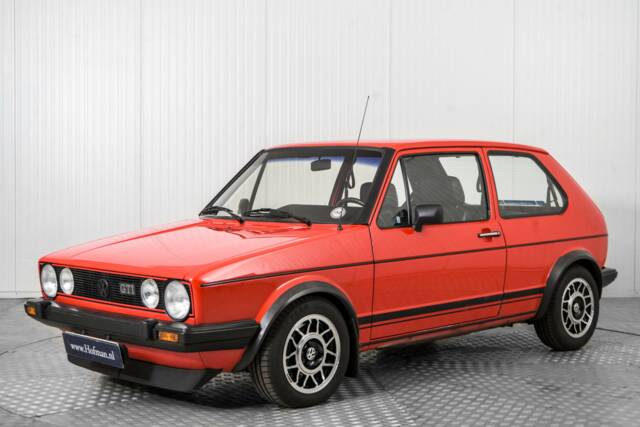
The GTI is readily distinguished by its black grille edged in red, GTI badging, wheel-arch extensions, lower suspension and deep front spoiler. Early cars combined the four-spoke sports steering wheel, golf-ball gear knob and bolstered tartan-trimmed seats; front disc brakes were ventilated on the GTI, while the rear remained drum-braked. Anti-roll bars were fitted to sporting versions.
In the supplied marketplace statistics, Typ 17 cars account for 100% of Volkswagen Golf listings and 100% of listing views recorded for the stated manufacturer-code comparison. The figures describe this supplied dataset rather than the overall classic-car market.
Technical data for the Volkswagen Golf Typ 17
Special editions and notable versions
The Golf GTI Pirelli was a 1983 farewell edition. It combined distinctive Pirelli alloy wheels with a leather steering wheel, sunroof, MFA trip computer, four grille-mounted headlamps, electrically adjustable mirrors and extended trim.
Period tuning also produced rare alternatives. Oettinger conversions such as the 16S and 2000E 16V used more powerful multi-valve engines, making them materially different from the standard GTI. Their limited nature and specification should be supported by documentation when assessing an individual car.
Weak spots and checks before purchase
No model-specific weak spots are provided in the supplied information. For a Typ 17, the available documentation is therefore especially useful when comparing cars: instruction booklets, service books, factory papers and, where present, Volkswagen certificates of authenticity can help establish the car’s specification and history.
Check that the engine, gearbox, wheel and interior specification match the version claimed. This matters particularly for GTIs and Pirelli editions, which can be identified by equipment such as the grille treatment, wheels, tartan upholstery, sports controls and—on the Pirelli—its listed extended equipment.
Engines, transmission and driving characteristics
The standard 1.1-litre Golf produced approximately 50 hp, while larger carburetted 1.3-, 1.5- and 1.6-litre engines broadened the range. The GTI’s 1.6-litre, 1,588 cc K-Jetronic engine developed around 110 hp and 140 Nm. Later 1.8-litre GTIs produced approximately 112–114 hp and 148 Nm. Reported GTI performance is 0–60 mph in about 8.2–9.1 seconds and a top speed of 180–182 km/h.
MacPherson struts at the front and a torsion-beam rear axle define the chassis, with anti-roll bars on sportier versions. The GTI pairs this layout with a lower ride height and ventilated front discs. Four-speed manuals were fitted initially, with five-speed gearboxes appearing later; automatic transmission was confined to selected non-GTI versions.
- Golf GTI 1.6 — 1,588 cc Bosch K-Jetronic injection, around 110 hp and 140 Nm; the original fuel-injected performance model.
- Golf GTI 1.8 — 1,780 cc, approximately 112–114 hp and 148 Nm; later GTI specification, generally paired with the five-speed manual.
- Golf GTD — the range’s turbo-diesel sporting derivative and Volkswagen’s first turbo-diesel Golf.
- Golf GLS — a higher-trim alternative, available with a three-speed automatic and more elaborate equipment. undefined
Design, cabin and equipment
Giugiaro’s Italdesign body is defined by straight beltlines, a short front overhang and a practical hatchback tail. The three-door and five-door shells share the same compact proportions, while the Cabriolet’s Karmann conversion is distinguished by its open body and production extending beyond the Mk1 hatchback.
GTI details are unusually specific: a black grille with red surround, plastic wheel-arch extensions, a large front spoiler and alloy wheels including Tarantula designs; later Pirelli editions received their own Pirelli wheels. Inside, early GTIs used a four-spoke steering wheel, golf-ball gear knob and bolstered front seats in tartan patterns combining black with red, white or orange.
Depending on trim and year, factory equipment could include a manual or electric sunroof, heated rear window, intermittent wipers, internally adjustable right-hand mirror, head restraints, rear seat belts, centre-console auxiliary gauges, fog lamps and AM/FM radio. Wheel choices ranged from steel wheels to ATS LM, BBS, Tarantula and Pirelli alloys.
Documentation, colours and competition use
Period colours include Mars Red (LA3A), Inari Silver, Helios Blue, Lhasa Metallic and black. Standard wheels were commonly 13-inch items, while the Pirelli edition used 15-inch alloys; later aftermarket conversions may carry 16- or 17-inch wheels.
The Mk1 platform was used in Group 2 and Group A rally specifications, with competition parts and homologation-related equipment available. A car advertised with motorsport preparation or tuner modifications should be distinguished clearly from an unmodified production Golf.
Volkswagen Golf Typ 17 summary
A Volkswagen Golf Typ 17 is the 1974–1983 first-generation hatchback that replaced the Beetle with front-wheel drive, a transverse water-cooled engine and a compact five-seat layout. Buyers can choose between simple 1.1-litre cars, better-equipped GLS models, diesel and GTD derivatives, the Karmann-built Cabriolet and the GTI. For a performance-focused Mk1, the 1.6- and 1.8-litre GTIs are defined by K-Jetronic injection or later 1.8-litre power, low weight, distinctive red-edged grille and tartan interior; the 1983 Pirelli GTI adds a clearly specified farewell-edition equipment package.