Buick Sport Wagon classic cars for sale
The Buick Sport Wagon combines innovative roof design with midsize practicality, setting itself apart from other American station wagons of the 1960s and early 1970s. Especially recognisable by its raised roof with skylights and its status as Buick’s only luxury wagon of its era, it continues to attract attention among enthusiasts.
Search results
Currently, there are no matching listings for your search.
Create search alert
Let yourself be notified as soon as a listing is published that matches your search filters.
Create listing
Do you have a Buick Sport Wagon that you want to sell? Then create a listing now.
Create listingBuick Sport Wagon listing references from Classic Trader
Below you will find listings related to your search that are no longer available on Classic Trader. Use this information to gain insight into availability, value trends, and current pricing for a "Buick Sport Wagon" to make a more informed purchasing decision.
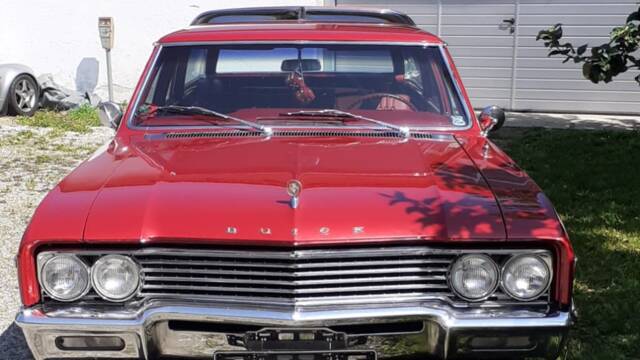
1965 | Buick Sport Wagon
Panorama Dachreeling

Create search alert
Let yourself be notified as soon as a listing is published that matches your search filters.
Create listing
Do you have a Buick Sport Wagon that you want to sell? Then create a listing now.
Create listingBuick Sport Wagon Classic Cars: Prices & Market Values
History of the Buick Sport Wagon
Introduced in 1964, the Buick Sport Wagon responded to growing demand for versatile family cars with an upscale touch. Built on an extended wheelbase version of the Buick Skylark, it distinguished itself with unique features such as an elevated roofline and skylights, emphasising both light and space. Sharing much of its architecture with the Oldsmobile Vista Cruiser and other GM models, the Sport Wagon maintained Buick’s reputation for comfort and refinement. Throughout its three generations, spanning 1964–67, 1968–69, and 1970–72, it was the only Buick station wagon occupying the luxury segment—until the return of the full-size Estate Wagon in 1970.
Model History
The first generation Buick Sport Wagon (1964–1967) featured the hallmark skylight roof above the rear seating and cargo area, and carried forward the comfort-focused engineering of the Skylark. The second generation (1968–1969) continued with subtle design updates and the sharing of platforms with other GM divisions. The final generation (1970–1972) simplified the line-up as Buick’s Estates Wagon re-entered the catalogue, gradually replacing the Sport Wagon in Buick’s station wagon hierarchy. Over its run, the Sport Wagon consistently offered upscale yet practical motoring.
Highlights and Unique Features
One of the Sport Wagon’s standout features is its panoramic skylight roof stretching above the second row and luggage compartment, a trait rarely seen among its contemporaries. The raised roof not only offers increased headroom but makes for a striking silhouette, paired with Buick’s luxury trim and comfort-oriented suspension tuning. As of now, the Sport Wagon accounts for 100% of Buick classic car listings in its class on our marketplace, indicating both a tailored niche and the model’s singular position within the brand’s vintage range.
Technical Data
Special Editions and Collectible Models
While major limited editions were not common, early-production models with original skylight glass and well-preserved interiors are particularly sought after by collectors. Models equipped with premium factory options—such as power tailgates or period-correct woodgrain exterior trim—stand out as more collectible within the series.
Weak Spots and Common Issues
No specific weak spots or common mechanical issues have been documented with the data provided. However, as with many 1960s and 1970s GM station wagons, potential buyers should inspect for corrosion in structural areas, check the condition of the skylight seals, and verify the operation of all power accessories to ensure long-term reliability.
Engine and Performance, Transmission and Handling
Depending on year, the Sport Wagon was available with a selection of six-cylinder and V8 engines, paired with either manual or automatic transmissions. Suspension tuning favoured comfort for highway cruising, although the extended wheelbase improved stability compared to shorter models. The wide track and robust drivetrain make for a dependable touring estate, while the panoramic roof design ensures every trip is accompanied by ample natural light. Enthusiasts often highlight the 1964–67 versions for their full-length skylight panels, while 1970–72 models are noted for their improved handling and updated mechanical systems.
Interior, Comfort, Exterior and Design
Interior appointments in the Sport Wagon included wide bench seats, high-grade upholstery (available in a range of period-correct colours), and a well-arranged dashboard featuring classic GM switchgear. The raised roof and glass panes offer a spacious cabin environment. Notably, original factory air conditioning, roof rails, and premium radio units reflect typical US luxury from the era. Externally, the sweeping roof, long-wheelbase proportions, and available brightwork or woodgrain elements underline the model’s distinct place in American station wagon design culture.
Other Features
The Sport Wagon's shared GM platform makes sourcing many mechanical and body parts relatively straightforward for restoration in the classic car scene. Its compatibility with a range of Buick and GM components facilitates parts procurement and customisation, whether aiming for an original-spec restoration or tasteful modification.
Summary
The Buick Sport Wagon remains uniquely positioned among American station wagons for its innovative raised skylight roof and practical luxury. Spanning three distinct generations, this model was central to Buick’s family car offering between the mid-1960s and early 1970s. Unmistakable design, shared heritage with other GM marques, and strong enthusiast interest ensure the Sport Wagon retains a clear identity on today’s classic car market.