Ferrari Formula 1 classic cars for sale
Ferrari Formula 1 cars epitomise the pinnacle of motorsport engineering, representing Maranello's most advanced technology of their era. With epoch-defining victories and constant technical evolution, these racecars stand as some of the most exclusive and technically ambitious vehicles in automotive history.
Résultats de la recherche
À l'heure actuelle, il n'y a pas d'annonces correspondant à votre recherche.
Create search alert
Let yourself be notified as soon as a listing is published that matches your search filters.
Create listing
Do you have a Ferrari Formula 1 that you want to sell? Then create a listing now.
Create listingFerrari Formula 1 listing references from Classic Trader
Below you will find listings related to your search that are no longer available on Classic Trader. Use this information to gain insight into availability, value trends, and current pricing for a "Ferrari Formula 1" to make a more informed purchasing decision.
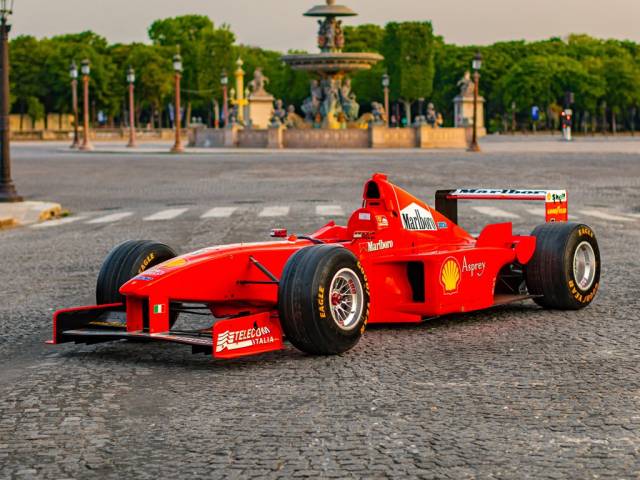
1998 | Ferrari F 300
1998 Ferrari F300
Create search alert
Let yourself be notified as soon as a listing is published that matches your search filters.
Create listing
Do you have a Ferrari Formula 1 that you want to sell? Then create a listing now.
Create listingFerrari Formula 1 Classic Cars: Prices & Market Values
History of Ferrari Formula 1 Cars
Ferrari's Formula 1 project is the most enduring in modern racing, led by Scuderia Ferrari and rooted in the company's heritage as both constructor and competitor. The pursuit of Grand Prix success defined Maranello's philosophy from the 1950s through the late 1990s, weathering fierce competition and major regulation changes. After a championship drought post-1979, Ferrari meticulously rebuilt its F1 operations, culminating in the landmark 1998 season—highlighted by an overhauled single-seater engineered to new aerodynamic and safety regulations. Key figures like Michael Schumacher and technical mastermind Rory Byrne spearheaded a dynamic period that fused traditional craftsmanship with New Wave computational aerodynamics, yielding cars that played a central role in Ferrari's resurgence at the turn of the millennium.
Model History and Evolution
Each Ferrari Formula 1 season saw ground-up re-engineering to match shifting regulations and performance targets. The F300, introduced for the 1998 season, exemplifies this: built around a new 3.0-litre, 80° V10 (Tipo 047) producing about 800 bhp at 17,500 rpm, it followed a lineage of naturally aspirated twelve- and ten-cylinder predecessors. Its direct predecessor was the F310B, with successors incorporating further lessons in advanced aero and powertrain refinement. Model cycles have tight iteration windows, often with only a few chassis constructed per year—some reserved as spares or for private testing—rendering every original car unique to its race history and setup. This period established the technical foundations for Ferrari's early 2000s dominance in both Constructors' and Drivers' Championships.
Technical Highlights and Racing Achievements
The Ferrari F300 and its contemporaries stand out for their continual adaptation to rule changes and track-specific challenges. The Tipo 047 V10 set new standards with high-revving efficiency and robust torque curves. Key chassis features include the adoption of torsion bar suspension and a pushrod layout at all four corners, vertical front shock absorbers, and innovative exhaust routing—such as Willem Toet's 'periscope' system optimising heat dissipation and packaging. Aerodynamics benefited from narrowed bodywork and aggressive intake placement. High-carbon composite brakes, sequential 7-speed gearboxes, and signature 13-inch Bridgestone magnesium wheels rounded out the technology package. These machines secured Grand Prix victories throughout the 1998 campaign (notably in Argentina, Canada, France, the UK, Hungary, and Italy) and laid groundwork for a string of championship titles in the following years.
Technical Data
Special Editions and Unique Chassis
Every Ferrari Formula 1 car is a limited-run creation, with just a handful of chassis produced each season for racing, testing, and reserve duties. Particular interest falls on original, race-winning chassis or those with direct historical provenance (e.g., driven by Michael Schumacher or Eddie Irvine during milestone Grand Prix wins). These race-used examples are highly sought-after due to their exclusive histories and links to specific moments in F1 history.
Engine, Performance, Gearbox and Handling
Late-1990s Ferrari F1 cars deliver explosive acceleration and exceptional cornering abilities thanks to their V10 engines, magnetically responsive sequential gearboxes, and precision chassis geometry. The pushrod suspension design, coupled with high-downforce aerodynamic profiles, provides race-spec handling characteristics, requiring experienced pilots and dedicated maintenance teams to extract peak performance. Among Ferrari Formula 1 classics, chassis tied to the 1998 F300 series are particularly noteworthy, having powered numerous high-profile Grand Prix victories and anchoring Ferrari’s approach to the radical technical changes of the era. The Tipo 047 engine and related hardware underscore Maranello’s engineering prowess of the time.
Interior, Comfort and Exterior Design Features
Inside the cockpit, Ferrari Formula 1 vehicles of the late 1990s offer a stripped-back, function-first driving environment—full carbon-fibre monocoque construction, minimalistic digital dashboards, and custom-moulded seats to each driver. Externally, compact bodywork, innovative aerodynamic surfaces, and advanced materials underpin both aesthetics and function. Special attention was paid to airflow management, with sidepod and engine cover intakes as well as the 'periscope' exhaust not only improving cooling, but shaping the car’s aggressive race silhouette. Every detail, from wheel nut design to livery and sponsor placement, reflects the practicalities and style of late-1990s F1 design practice.
Other Information
Only a few Ferrari F1 chassis from this era remain in private hands. Their provenance, including race history and original configuration, critically affects both appraisal and collectability. Cars of this distinction often serve as demonstration models at vintage racing events or as focal points in curated collections, showcasing the technology and competitive spirit that defined late-20th-century Grand Prix racing.
Summary
Ferrari Formula 1 classics such as the Tipo 047 F300 embody the zenith of 1990s racing technology. Each chassis tells a unique story of competition, technical progress, and motorsport culture. Their exclusivity and inextricable ties to peak moments in Maranello’s history secure their status within the world of historically significant racecars.