- Car
- Rainier (0 offers)
Buy Classic Rainier Cars
Rainier built imposing American luxury cars from 1905 to 1911, combining vast four-cylinder engines, brass-era craftsmanship and genuine competition credentials. Find a rare classic Rainier on Classic Trader and assess its history, originality and Australian import path with care.
Search results
Currently, there are no matching listings for your search.
Create search alert
Let yourself be notified as soon as a listing is published that matches your search filters.
Rainier listing references from Classic Trader
Below you will find listings related to your search that are no longer available on Classic Trader. Use this information to gain insight into availability, value trends, and current pricing for a "Rainier" to make a more informed purchasing decision.
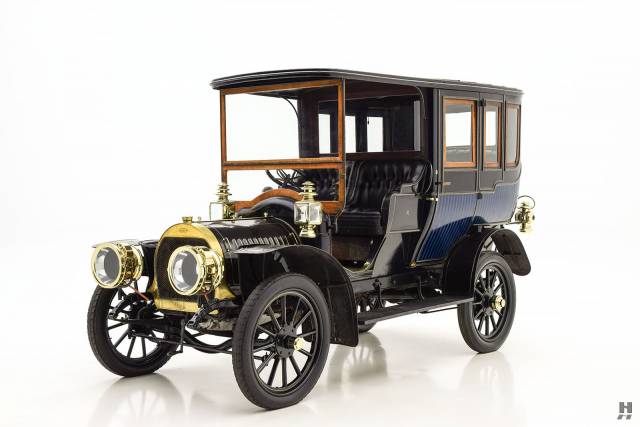
1907 | Rainier Model C
Rainier Model C
Create search alert
Let yourself be notified as soon as a listing is published that matches your search filters.
Rainier history: a brief but ambitious American marque
The Rainier Motor Car Company existed for only seven model years, yet it occupied a serious position in the American luxury-car world before the First World War. Founded by John T. Rainier at Flushing, Queens, in 1905, the company made cars for buyers who wanted more than everyday transport: substantial engines, formal coachwork, costly materials and the confidence to undertake long inter-city motoring. The company advertised its cars as “The Pullman of Motor Cars”, an apt comparison in an era when Pullman signified comfort and prestige rather than speed alone.
John Rainier had previous experience in electric vehicles and commercial work before turning to petrol cars. The first Rainiers were assembled in New York around purchased Garford chassis. The 1905–06 Model A was a 22/28hp four-cylinder five-seat tourer; it was followed by the more luxurious 30/35hp Model B town car in 1906 and the Model C touring and landaulet range during 1907. Early Rainiers were expensive even beside other American cars: a Model A listed at US$3,500, while Model B and C examples approached or exceeded US$4,000. They belonged in the same conversation as Pierce-Arrow, Lozier, Packard and Pope-Hartford, not with mass-market Fords.
The crucial step came in 1907. Concerned that reliance on outside chassis supply could restrict the business, Rainier moved production to Saginaw, Michigan, and established a factory intended to build complete cars. The 1908 Model D marked the result. It was physically larger, more powerful and notably more sophisticated than its predecessors, with a pressed nickel-steel chassis and a massive T-head four. A five- or seven-passenger touring body gave the owner real carrying capacity, while limousine coachwork addressed the chauffeur-driven market.
Rainier’s timing was unfortunate. The Panic of 1907 tightened credit, and a small manufacturer could have impressive assets but still lack the cash to pay wages and suppliers. About 300 cars were delivered in 1908, but the company entered receivership late that year. The Saginaw business was acquired by William C. Durant’s General Motors interests in 1909. GM retained Rainier as its intended upper-tier marque while the factory also supported the newly acquired Welch-Detroit and the Marquette Motor Company operation.
Under GM, the 1910 and 1911 Model F continued the big-car theme. The wheelbase grew to 119 inches for 1910 and 120 inches in 1911, and catalogue choice included roadster, close-coupled tourer, conventional touring car, limousine and landaulet bodies. However, GM’s financial upheaval and consolidation ended the experiment. Rainier production ceased after 1911, making the marque an unusually compact chapter in the history of American prestige motoring.
That short life is central to its appeal today. A Rainier is not a familiar American veteran car with a broad local parts network and regular club presence in Australia. It is a scarce, technically interesting Brass Era machine whose survival relies on individual custodians, specialist engineering and a deep research file. The right car therefore has a distinct appeal for a collector who values rarity and provenance over easy ownership.
Rainier highlights and defining qualities
Rainier’s defining quality was scale. The company did not pursue small, light runabouts. Even the earlier models were expensive four-cylinder touring cars, and the Model D and Model F were designed as high-status, long-wheelbase motorcars. Their large low-speed engines delivered the muscular, deliberate character buyers expected before multi-cylinder refinement became commonplace.
The Model D’s 6.76-litre T-head four is the headline feature. With a 5-inch bore and 5.25-inch stroke, it is an engine built for torque rather than revs. Separate inlet and exhaust valve chambers on opposite sides of the cylinder casting gave the T-head its name. The layout uses generous ports and valves, and contemporary performance was impressive enough for Rainier to contest endurance and speed events. Its make-and-break ignition, four-speed gearbox and overdrive top gear were expensive-car equipment, not a simplistic early-car specification.
Fine material specification also separates a Rainier from lesser contemporaries. Bonhams noted the extensive use of nickel steel, including the Model D’s pressed chassis rails. Brass fittings and lamps, a tall barrel-shaped radiator and elaborate coachbuilt timber-and-panel bodywork provide the expected period presence, but the underlying engineering deserves as much attention as the brightwork. A buyer should regard the chassis, engine castings, axle assemblies and gearbox as the car’s identity, not merely its dramatic silhouette.
There is a sporting dimension too. Rainier driver Louis Disbrow won the 200-mile Atlanta Cup, and a Rainier finished second in the 1909 24-hour race at Brighton Beach, ahead of a FIAT driven by Ralph de Palma and a Lozier driven by Ralph Mulford. This does not make every touring Rainier a racing car, but it confirms that the make was developed to withstand serious use. For a luxurious American tourer of this date, that endurance record is meaningful.
Rarity is both a highlight and a warning. Bonhams described chassis 1603, a 1908 Model D seven-passenger touring car, as the sole survivor of its type when it sold in London in 2021. Such claims need to be read as specific to the known surviving specification, rather than assumed for every Rainier, but they illustrate the tiny surviving population. A Rainier should be purchased for its individual evidence—chassis number, coachwork, history, original components and restoration quality—not because an online price guide suggests a tidy market category.
Rainier technical data
Published period specifications are not always perfectly consistent: ratings were often nominal, bodywork could be supplied in more than one form, and surviving cars may have later alterations. The following table is a useful starting point for identifying a listing, not a substitute for inspecting the particular car.
The Model D’s front-engine, rear-wheel-drive layout used leaf springs at both ends. Carfolio records 36 x 4 tyres at the front and 36 x 4½ at the rear for the 1910 50hp tourer. Those dimensions matter to an Australian buyer: tyres, tubes, wheels and hubs must be checked as a system, and a car with mismatched rims or unsafe aged tyres cannot be treated as ready for a country drive simply because the engine starts.
Do not confuse the historic 40/50hp or 45/50hp wording in auction catalogues with a modern, measured power claim. In period literature the designation was a rating range, and Bonhams specified the 1908 engine as 6,759cc and 50hp. Equally, do not assume a listed Model D has its original rear axle, carburettor, magneto or ignition parts. The documented history of chassis 1603 records a Pierce-Arrow rear axle fitted in the 1930s after the original half-shaft casing cracked; importantly, its original broken axle was retained. That is exactly the kind of alteration that requires disclosure, photographs and an informed judgement about preservation versus restoration.
Market overview and buying tips
For Australians, buying a classic Rainier is more like acquiring a museum-grade American veteran than purchasing a regularly traded marque. Public transactions are too scarce to establish a dependable model-by-model price range. Condition, provenance, originality, venue and body style can change value far more sharply than a nominal model designation.
One valuable public benchmark is the 1908 Rainier Model D 40/50hp seven-passenger touring car, chassis 1603, sold by Bonhams in London on 5 November 2021 for £167,900 including premium. That result followed a restoration completed between 2016 and 2021. Bonhams recorded more than £50,000 of restoration expenditure, including remanufactured or sourced ignition parts, rebuilt front axle and kingpins, clutch work, a ring gear, battery and starter, restored lamps and radiator, repainting, and over £19,000 on patterned red leather upholstery and trim. It is evidence of what a known, rare, usable Model D could achieve in a major auction, not a universal Rainier valuation and not an Australian landed cost.
At the other end of the spectrum, an apparently complete project can hide a much larger commitment. A cracked casting, incomplete ignition, worn gearbox gears, missing brass lamps, failed radiator core or rotten body framing can each require specialist work that is difficult to price before dismantling. Pattern parts are not stocked in Australia. Fabrication may be practical, but it should be quoted by a veteran-car engineer who understands the need to preserve fitting methods, materials and appearance. Budget for freight and lead time from North America or Britain, customs brokerage, careful crating, and the possibility that a one-off part must be made twice before it is right.
Before agreeing on price, obtain high-resolution photographs of the chassis number, engine number and any body or maker plates. Ask for an unbroken ownership chain where possible, period photographs, club records, auction catalogues, restoration invoices and a written schedule of known non-original parts. For a car said to be “restored”, establish what was restored, what was replaced and what was merely cleaned. A shiny brass radiator does not prove a sound core; fresh upholstery does not prove good ash framing; a running video does not prove that the clutch, lubrication and cooling systems tolerate a sustained road run.
Inspection should be hands-on and ideally carried out by a recognised Brass Era specialist near the car. Begin with the nickel-steel chassis: look for cracks around spring hangers, cross-members and engine mounts, crude welds, distortion and incorrect fasteners. Check front-axle beam condition, kingpin play, steering-box wear, tie rods, wheel bearings and the integrity of wooden-spoked wheels. On a large, heavy tourer, steering and braking defects are safety issues, not cosmetic bargaining points.
For the engine, inspect cylinder castings and valve-chamber covers for frost damage, previous repairs and corrosion around water passages. Ask how oil is delivered, whether the pump and lines work, and whether the engine has been warmed through rather than simply started from cold. Observe oil pressure if instrumentation is fitted, coolant circulation, smoke, compression consistency and crankcase leakage. Magneto, coil, batteries and make-and-break ignition components need a clear explanation, particularly if modern starting or electrical assistance has been added. Such additions can be sensible for touring, but workmanship and reversibility matter.
The four-speed transmission and final drive deserve a road test if safe and practical. Listen for gear tooth noise under load and overrun, confirm clutch take-up and check whether overdrive top gear engages as it should. Inspect the differential and both rear half shafts. Chassis 1603’s documented axle history demonstrates why a buyer must distinguish an intelligently engineered period repair from an undocumented substitution. A converted axle may make a car usable, but it changes originality and can affect future parts strategy.
Coachwork should be assessed inside and out. Lift carpets and cushions where permitted; probe the lower body, sill structures, running-board supports, door frames and hood bows for soft timber. Examine the hood mechanism, side curtains, windscreen frame, lamps, mudguards, radiator shell and nickel or brass fittings. Correct age-related patina can be highly desirable; careless over-restoration, chrome where nickel was appropriate, or modern screws in visible places can reduce the car’s integrity. The best survivor need not be the shiniest one.
Importing a left-hand-drive Rainier to Australia
A US-market Rainier will normally be left-hand drive (LHD). It is far older than 25 years, so it may be eligible for Australia’s older-vehicle concessional pathway, but federal import approval and state or territory registration remain separate matters. Do not treat any sales claim about LHD eligibility as a registration guarantee. Check the rules with the registration authority in the state where the car will live before you buy; their requirements for historic registration, inspections, lighting, steering and permitted use can differ.
The Australian Government’s Department of Infrastructure states that an approval must be obtained before importing a road vehicle. Applications are managed through ROVER, and the older-vehicle pathway requires evidence such as vehicle photographs, chassis/VIN identification and details of modifications. An approval can take time to assess; a vehicle arriving without approval is not released from customs control, and storage costs are the importer’s responsibility. For an early car with no modern VIN, resolve the chassis-number evidence and any allocated identification requirements well before it is loaded at a US port.
Shipping choice deserves the same care as the purchase inspection. A high-value, non-running or open-bodied Rainier is generally better suited to properly secured container transport than a casual roll-on/roll-off arrangement, but exact methods depend on its condition, dimensions and the shipper’s veteran-car experience. Confirm whether the hood, side curtains, loose lamps, tools and spare parts travel with the car; document every item and insure to an agreed value. Include inland US collection, export paperwork, marine insurance, container packing, Australian port fees, customs clearance, biosecurity inspection, local transport and storage in the landed budget rather than focusing on the hammer price.
Australia’s biosecurity requirements are exceptionally important for a veteran car. The Department of Agriculture’s BICON conditions require used vehicles to be free of biosecurity risk material before arrival, and all consignments require inspection. Soil, seeds, insects, plant matter, nests and debris can accumulate in chassis rails, mudguards, upholstery, floorboards, tyre treads, wire wheels and inside a folded hood. Cracked tyres can retain contamination. A vehicle found unacceptably dirty can require treatment or be directed for export at the importer’s expense. Arrange professional cleaning and detailed pre-shipment photographs, then ensure the container itself and packaging are clean.
Customs duty, GST, luxury car tax where applicable, broker charges, quarantine costs and state on-road costs should be modelled with a qualified Australian broker from the actual invoice and freight figures. This page is not tax advice. The key buyer lesson is simple: a Rainier’s purchase price is only one element of the commitment. Build a contingency for currency movement, specialist inspection, cleaning, port delay and one-off mechanical work after arrival.
Driving a Rainier
A Rainier is not a car to hustle like a later sports car. From the high driving position, the bonnet seems to extend into another postcode, the brass and tall radiator announce the car’s presence, and the huge four-cylinder engine sets a slow, emphatic rhythm. The appeal lies in learning the machinery: the sequence of ignition and fuel preparation, the heavy clutch, the deliberate gear selection and the anticipation required by its brakes and steering.
Once moving, the engine’s long-stroke torque is the memorable feature. A Model D does not need to be revved hard to feel purposeful; it gathers pace with the authority of a large Edwardian tourer. The four-speed gearbox, including its high top gear, made long-distance motoring more credible in its time. Today, sensible touring means matching pace to the car’s steering, tyres, cooling capacity, road surface and visibility, not testing a century-old chassis against modern traffic.
Australian ownership adds its own pleasures and constraints. A carefully prepared Rainier can be a striking entrant at veteran and historic events, but heat, distance and sparse services magnify the importance of cooling, fuel planning, tyres and recovery arrangements. LHD driving on Australian roads requires extra care around overtaking and lane placement. For many owners, the best experience is an escorted club run on suitable roads, with tools, water, fire safety equipment and a support vehicle rather than an ambitious solo highway trip.
Design and coachwork
Rainier design belongs to the confident, vertical architecture of the Edwardian luxury car. The Model D’s tall, barrel-shaped radiator, long hood, upright windscreen and generous rear accommodation give it a distinctly transatlantic presence, yet Bonhams reasonably compared its visual quality with European upper-crust cars such as Delaunay-Belleville, Hotchkiss and Spyker. It is more formal than a lightweight sporting runabout, but it is not anonymous.
Body styles allowed the customer to choose between open touring sociability and enclosed dignity. A seven-passenger tourer—with its deep rear compartment, folding hood and side curtains—was a substantial family or staff-carrying car. Limousines and landaulets served an owner who expected a chauffeur and weather protection. The 1911 roadster offered a shorter social brief, while the close-coupled tourer retained luxury in a more compact passenger arrangement.
When studying a car, look beyond paint colour. The relationship between hood, cowl, windscreen, doors, mudguards, lamp brackets, running boards and rear tonneau should make visual sense. A coachbuilt body may have been repaired many times over its life, and that is not automatically a fault; early cars were used, rebuilt and updated. What matters is whether the workmanship is sympathetic, structurally sound and honestly recorded. Originality is strongest when supported by period photographs, physical evidence and a coherent history rather than by a seller’s assurance alone.
Competition, preservation and provenance
Rainier’s competition history gives the marque useful depth, but preservation is the more immediate collector story. The surviving 1908 Model D sold by Bonhams had a remarkable Californian chain of custody: delivered new to the Asbury family, passed to chauffeur Calvin Johnson in the 1930s, then kept by the Buess family for around six decades. It was known to the Horseless Carriage Club from its early years. That kind of documented continuity can be more valuable than a perfect cosmetic finish because it explains why particular features exist and which components are genuine.
For a prospective Australian custodian, seek a car with a similar level of evidence where possible. A substantial file can make future maintenance safer, help a specialist reproduce missing components accurately, support historic registration and reassure the next buyer. Conversely, an impressive-looking car with unidentified chassis numbers, absent import/export documents, no restoration photographs and vague statements about “older work” should be priced as an uncertainty.
The Rainier community is necessarily international. Owners should expect to consult North American veteran-car clubs, auction archives, museum material, specialist restorers and fellow collectors rather than rely on a local franchise network. That is part of the car’s attraction: owning one makes the buyer a custodian of a small, well-defined piece of American automotive history.
Summary: buying a classic Rainier
A classic Rainier offers exceptional rarity, imposing Edwardian design and a real engineering story. The 1905–07 Model A, B and C establish the New York beginnings; the 1908–09 Model D represents the marque at its independent peak; and the long-wheelbase Model F shows GM’s short-lived attempt to preserve Rainier as a luxury name. A big four-cylinder engine, quality chassis materials and documented endurance success give the make substance behind its visual theatre.
Buy the individual car, not the badge. Prioritise chassis identity, coachwork integrity, mechanical completeness, restoration evidence and a specialist inspection. Treat the £167,900 Bonhams result for the restored 1908 Model D as a useful historical comparator, not a price promise. For an Australian import, secure ROVER approval before shipping, confirm LHD and registration rules locally, budget every landed cost and prepare the car meticulously for biosecurity inspection. With those disciplines in place, a Rainier can be a magnificent, deeply distinctive addition to an Australian collection.