Toyota Aygo classic cars for sale
The Toyota Aygo stands out among compact city cars thanks to its efficient use of space, low fuel consumption, and pragmatic engineering. Appealing to drivers looking for reliability and a small footprint, it perfectly suits urban mobility demands. Discover more about the Aygo's history and unique characteristics.
Search results
Currently, there are no matching listings for your search.
Create search alert
Let yourself be notified as soon as a listing is published that matches your search filters.
Create listing
Do you have a Toyota Aygo that you want to sell? Then create a listing now.
Create listingToyota Aygo listing references from Classic Trader
Below you will find listings related to your search that are no longer available on Classic Trader. Use this information to gain insight into availability, value trends, and current pricing for a "Toyota Aygo" to make a more informed purchasing decision.
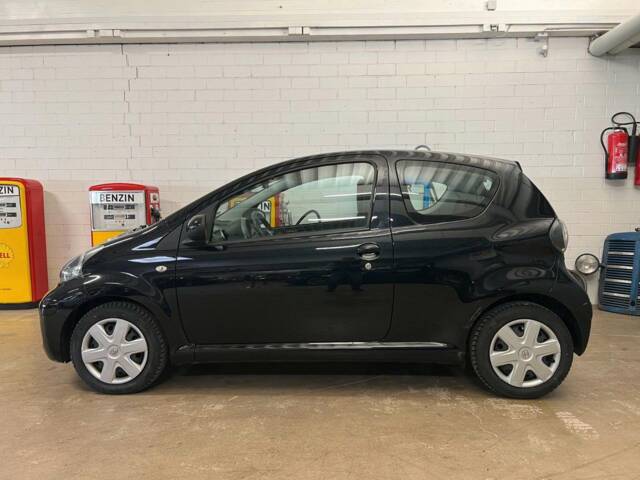
2009 | Toyota Aygo
Toyota Aygo AYGO Cool

Create search alert
Let yourself be notified as soon as a listing is published that matches your search filters.
Create listing
Do you have a Toyota Aygo that you want to sell? Then create a listing now.
Create listingToyota Aygo Classic Cars: Prices & Market Values
Introduction and history of the Toyota Aygo
The Toyota Aygo made its debut at the 2005 Geneva International Motor Show, marking Toyota's first foray into the A-segment city car market for Europe. Developed and produced through a partnership with PSA Peugeot Citroën at the TPCA plant in Kolín, Czech Republic, the Aygo was the result of a collaboration that also birthed the Citroën C1 and Peugeot 107/108. Production ran from 2005 until 2021, when the Aygo was succeeded by the Aygo X crossover. The Aygo appealed especially to drivers navigating congested European cities, thanks to its compact size and agile handling while maintaining Japanese standards of build quality and efficiency.
Model history
The Aygo’s journey began in 2005, sharing its underpinnings and assembly line with the Citroën C1 and Peugeot 107 before both French models evolved into the 108 and newer C1. The first generation (2005–2014) established the Aygo as a minimalist and functional hatchback available in three and five-door configurations. The 2014 facelift brought sharper lines and a more expressive front styling. The second generation, starting in 2014, enhanced comfort, safety, and infotainment while maintaining the agile urban-focused character. In 2021, the Aygo was replaced by the Aygo X, which shifted the focus towards a crossover style.
Highlights of the Toyota Aygo
Toyota engineered the Aygo with simplicity and efficiency in mind, prioritising low operating costs and straightforward maintenance. The Aygo’s three-cylinder, 998 cm³ petrol engine provided a balance between performance and economy. Features like a folding rear seat, height-adjustable rear headrests, and a variable steering wheel made the most of the limited space. Safety systems included driver, passenger, curtain, and side airbags as well as ABS, EBD, stability and traction control, and electronic immobiliser. According to current supply and demand figures, the Aygo emphasises its dominance in Toyota’s small car segment:
Technical data
Special Editions and Collectible Models
Toyota released several Aygo special editions and trim packages throughout its production, often distinguished by unique colour schemes, exclusive alloys, or extra equipment. These may include bright paint finishes or interior accent packs and limited-edition badges. However, none reached a status of strict collectibility in the traditional sense.
Engine and Performance, Transmission and Handling
With its light chassis and compact dimensions, the Aygo’s three-cylinder engine delivers an agile and responsive driving experience at city speeds. The 50 kW (68 PS) engine, paired to a 5-speed manual, prioritises fuel economy and urban flexibility, with a tight turning circle and surprisingly nimble handling for a small hatchback. Manual steering setup and a low curb weight help keep the car lively yet controllable. Its modest performance is offset by low running costs and ease of maintenance. Notable configurations include both 3- and 5-door versions, all powered by the 1KR-FE engine. The fuel-efficient Euro 4/5-compliant engine keeps emissions low, making even early models relevant for city driving regulations.
Interior, Comfort, Exterior and Design
Designers focused on maximising interior space in a compact footprint. The wide-opening doors and vertical tailgate ease access, while the folding rear bench and height-adjustable rear headrests improve utility. Early Aygo models feature functional interiors with hard-wearing materials and minimal fuss, while later facelifted examples add more playful design elements and colours. Standard features often include power steering, radio/CD player, adjustable steering wheel, and central locking. Limited editions sometimes featured custom upholstery, contrasting details on exterior plastics, and alloy wheels. Accessories like aftermarket audio or navigation were frequently fitted.
Other relevant features
The Aygo’s efficient use of space, sturdy safety specification, and straightforward mechanics make it a sought-after entry-level city vehicle. Alarm systems and immobilisers were standard or often fitted, and Euro emission classes enabled use in cities with stricter regulations. Insurance and tax costs remained low owing to the Aygo's small engine and lightweight construction.
Summary
The Toyota Aygo's success is rooted in intelligent engineering, compact size, and economical operation. With its status as a former city champion in Toyota’s line-up, the Aygo remains practical and attractive for enthusiasts seeking a reliable, urban-friendly classic.