Renault Scénic classic cars for sale
The Renault Scénic was Europe’s first small MPV, debuting in the late 1990s as an innovative family car combining compact proportions with remarkable interior versatility. With a legacy of pioneering practicality, distinct design and models ranging from efficient petrols to the latest fully electric E-Tech, the Scénic has played a defining role in the evolution of people movers.
Search results
Currently, there are no matching listings for your search.
Create search alert
Let yourself be notified as soon as a listing is published that matches your search filters.
Create listing
Do you have a Renault Scénic that you want to sell? Then create a listing now.
Create listingRenault Scénic listing references from Classic Trader
Below you will find listings related to your search that are no longer available on Classic Trader. Use this information to gain insight into availability, value trends, and current pricing for a "Renault Scénic" to make a more informed purchasing decision.
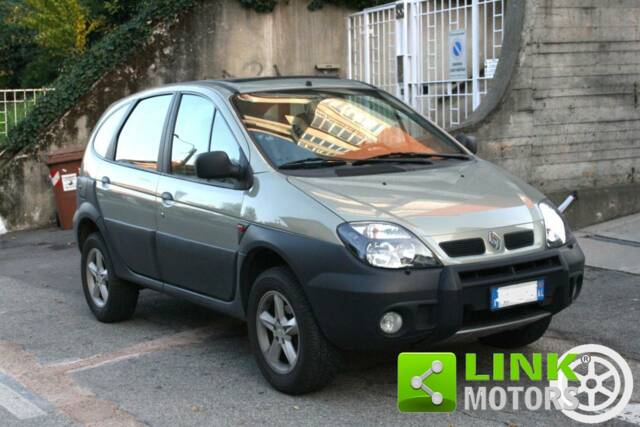
2000 | Renault Scénic RX4 2.0
RENAULT Scenic RX4 CON SOLI 98.000 KM! PRENOTATA

Create search alert
Let yourself be notified as soon as a listing is published that matches your search filters.
Create listing
Do you have a Renault Scénic that you want to sell? Then create a listing now.
Create listingRenault Scénic Classic Cars: Prices & Market Values
History of the Renault Scénic
The Renault Scénic appeared in 1996 as the continent’s first compact multi-purpose vehicle specifically designed for family use. Developed on the Renault Mégane platform, it won the European Car of the Year award in 1997, demonstrating immediate recognition for its ingenious concept and usability. Over the years, the Scénic has adapted to changing demands, culminating in its transformation into a full electric vehicle with the new E-Tech generation in 2024.
Model history of the Renault Scénic
The Scénic’s roots can be traced to Renault’s pursuit of family-friendly cars with flexible interiors. Derived from the Mégane, the first generation (1996–2003) offered sliding and folding rear seats that set new standards for the segment. Subsequent iterations further developed comfort and safety, with the Grand Scénic providing even more space. After several generations and numerous facelifts, Renault ceased the conventional combustion Scénic in 2022 and relaunched the Scénic E-Tech in 2024 as a battery-electric MPV.
Highlights of the Renault Scénic
The Scénic is credited with introducing truly modular seating to a mainstream audience, allowing owners to quickly adapt the cabin for varying needs. Notable is its combination of compact external dimensions and surprisingly capacious interior. The model has continuously offered efficient engines and robust safety features across generations. The 2001–2003 version, for example, combines a 1,255 kg kerb weight with five full-sized seats and a maximum towing capacity of 1,250 kg.
Technical data of the Renault Scénic
Special Editions and Collectible Models
Throughout its history, Renault offered various Scénic special editions—often with unique interior trims, enhanced multimedia systems or distinctive paint options. While many trimmed versions were specific to regional markets or tied to collaborations, none have reached the status of limited-production high-performance or luxury derivatives. Nevertheless, certain early or rare specification Scénics may appeal to collectors interested in key moments of automotive design evolution.
Weak Spots and Common Issues
For the classic Renault Scénic, there are no specific documented weak points in the provided data. However, typical issues associated with early 2000s MPVs include attention to the condition of interior mechanisms, electrics, and rear seat adaptability mechanisms due to frequent use. Checking the history of regular servicing, particularly on suspension and door electronics, is advisable.
Engine and Performance, Transmission and Handling
With a maximum torque of 148 Nm and peak speed of 180 km/h, the early 2000s Scénic delivers reliable and predictable driving characteristics suited to family transport. The 5-speed manual transmission and front-wheel drive arrangement ensure handling is easy, especially in city and suburban use. Acceleration from 0 to 100 km/h in 13.8 seconds marks it as purposeful for its class rather than sporty. Among the most represented in the market are the RX-coded models, forming almost 80% of supply and over 96% of listing views. Their balanced specification and wide availability make them the reference for classic Scénics.
Interior, Comfort, Exterior and Design
The Scénic is known for its elevated seating position, panoramic glass, multi-adjustable rear seats and user-oriented cabin storage. Renault’s use of practical plastic and durable cloth dominated these years, with special editions occasionally offering upgraded fabrics or two-tone dashboards. The modular cabin design, coupled with a relatively high roof and spacious boot, defines the Scénic’s enduring appeal. Accessories often included roof rails, additional 12V sockets, and removable rear seats, addressing real-world versatility needs.
Other relevant features
An essential aspect of the Scénic is its adaptability to widely varying owner requirements—from family daily driving to economical holiday touring. With emission standards set at Euro 3 for early 2000s models and a generous payload, the Scénic also became a favourite for light utility tasks across Europe.
Summary
The Renault Scénic broke the mould for compact family cars and small MPVs, combining space efficiency, innovative cabin design, and adaptable performance. Its strong presence in listings and views reflects an enduring reputation for practicality and reliability. In classic circles, the Scénic stands as a milestone in European automotive design, further cemented by its transition to electric power in recent generations.