- Car
- Massey-Ferguson (0 offers)
Buy Massey Ferguson Classic Tractors
From the "Little Grey Fergie" TE20 to the 100 Series, Massey Ferguson tractors helped build Australian agriculture. Coventry-built Perkins diesels that worked the wheatbelt, the dairy farms, and the outback — now prized by collectors across the country.
Search results
Currently, there are no matching listings for your search.
Create search alert
Let yourself be notified as soon as a listing is published that matches your search filters.
Create listing
Do you have a Massey-Ferguson that you want to sell? Then create a listing now.
Create listingMassey-Ferguson listing references from Classic Trader
Below you will find listings related to your search that are no longer available on Classic Trader. Use this information to gain insight into availability, value trends, and current pricing for a "Massey-Ferguson" to make a more informed purchasing decision.
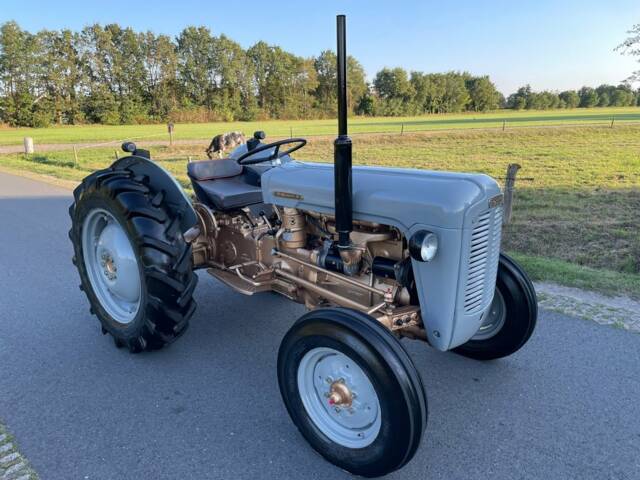
1957 | Massey-Ferguson MF 35
Massey Ferguson FE35 "Gold Belly" Tractor | 1957 | Route 66 Auctions - For sale by auction. Estimate 16200 EUR

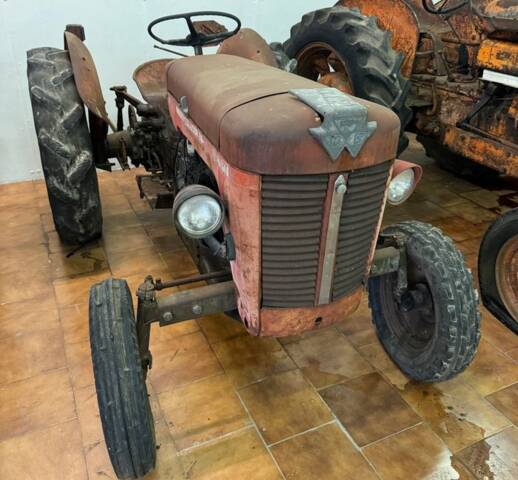
1964 | Massey-Ferguson MF 35
Trattore Massey Ferguson - Type 30_8 - NO RESERVE - 1964
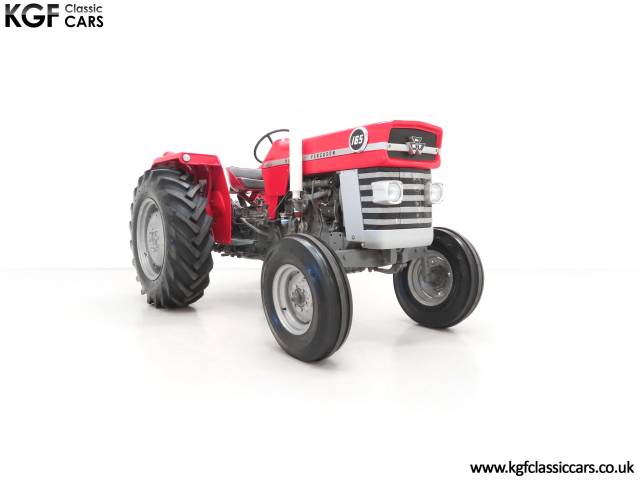
1971 | Massey-Ferguson MF 165
A Fully Restored and Fully Functioning Massey Ferguson MF165 in Wonderful Cond

Create search alert
Let yourself be notified as soon as a listing is published that matches your search filters.
Create listing
Do you have a Massey-Ferguson that you want to sell? Then create a listing now.
Create listingHistory & Heritage
The story of Massey Ferguson begins with two parallel threads that converged in 1953 to create one of the most important names in agricultural machinery.
In Canada, Daniel Massey founded the Newcastle Foundry and Machine Manufactory in 1847. By 1891, after merging with competitor A. Harris, Son & Co., Massey-Harris had become the largest agricultural equipment manufacturer in the British Empire.
In Northern Ireland, engineer Harry Ferguson developed what would become the single most important innovation in tractor history: the three-point hydraulic linkage with automatic draft control. Patented in 1925, this system allowed tractor and implement to function as a single unit — a principle that every modern tractor still uses today. After a partnership with Henry Ford (the Ford-Ferguson 9N, 1938–1947) ended in acrimony, Ferguson established his own company and, in 1946, launched the Ferguson TE20 — the legendary "Little Grey Fergie".
The TE20 was built under contract by the Standard Motor Company at their Banner Lane factory in Coventry, England. By the time production ended in 1956, over 500,000 TE20 tractors had been built.
In August 1953, Ferguson merged his company with Massey-Harris to form Massey-Harris-Ferguson Ltd., shortened to Massey Ferguson in 1958. In 1959, the company acquired both Perkins Engines of Peterborough and full ownership of the Banner Lane factory. Perkins diesels under Coventry-built chassis became the formula for decades of success.
The 100 Series — marketed as "The Red Giants" — launched at the 1964 Smithfield Show in London. The MF 135, MF 165, and MF 175 became instant bestsellers. Between 1964 and 1979, 413,153 MF 135s were built at Coventry alone.
Massey Ferguson in Australia
Massey Ferguson tractors arrived in Australia through the well-established distribution networks of Massey-Harris, which had been serving Australian farmers since the late 19th century. The TE20 was one of the first compact tractors many Australian smallholders could afford, and it found particular favour in dairy farming, vineyards, and market gardens across Victoria, South Australia, and Tasmania.
The MF 135 became a staple of Australian farms from the 1960s through the 1970s. Its combination of compact size, reliable Perkins diesel, and powerful Ferguson hydraulics suited the diverse conditions of Australian agriculture — from the irrigated horticulture of the Murray-Darling Basin to the mixed farming of the wheat-sheep belt. Many Australian-delivered MF 135s and MF 165s are still working on farms today, a testament to the durability of their Perkins engines and Coventry-built chassis.
After financial difficulties in the 1980s, Massey Ferguson was acquired by American AGCO Corporation in 1994. The Banner Lane factory closed on Christmas Eve 2002, with production moving to Beauvais, France.
Highlights & Features
What makes Massey Ferguson the most collected tractor marque in Australia comes down to three factors: historical significance, mechanical simplicity, and outstanding parts availability.
The Ferguson System: Harry Ferguson's hydraulic three-point hitch with automatic draft control was the technological foundation. Every modern tractor uses a version of this system. Owning a classic Massey Ferguson means owning a piece of engineering history.
Perkins Diesel Engines: The Perkins engines fitted from 1959 onwards — particularly the AD3.152 (3-cylinder, 2.5-litre) in the MF 135 and the AD4.203 (4-cylinder, 3.3-litre) in the MF 165 — are renowned for their durability. In Australian conditions — heat, dust, and long working days — these engines proved remarkably resilient. Their straightforward construction allows repairs that even amateur mechanics can undertake.
Australian Heritage: Many Massey Ferguson tractors have been on Australian farms for 50+ years, often in the same family. These are machines with provenance — tractors that cleared the land, worked the dairy, and taught generations to drive. For Australian collectors, a Massey Ferguson is often not just a machine but a family heirloom.
Parts Supply: Despite being built in Coventry, parts availability for classic Massey Ferguson tractors in Australia is excellent. Specialist importers, local agricultural machinery dealers, and online suppliers ensure that virtually every component can be sourced.
Technical Data
Multi-Power Transmission: The optional powershift gearbox doubled the ratios and allowed gear changes under load via a hydraulic clutch. Multi-Power models command a premium among collectors.
Market Overview & Buying Tips
The Australian market for classic Massey Ferguson tractors is active and growing. Vintage tractor collecting has become increasingly popular across rural Australia, with dedicated shows, ploughing days, and tractor pulls drawing large crowds.
Price Guide by Model (2024–2026, AUD)
Ferguson TE20 "Little Grey Fergie":
- Project/renovation: A$3,000–5,000
- Good working condition: A$5,500–10,000
- Fully restored/show quality: A$12,000–22,000
- Rare variants (TE-F 20 Diesel, Industrial): A$8,000–15,000+
MF 35 / FE 35:
- Project: A$2,500–4,500
- Good condition: A$5,500–10,000
- Restored/show quality: A$15,000–22,000
MF 135:
- Project/tired runner: A$3,500–6,000
- Good working condition: A$7,000–14,000
- Multi-Power variant: add A$800–2,000
- Restored/show quality: A$20,000–40,000
- Note: Australian-delivered examples with documented local provenance often command a premium over imported machines.
MF 165:
- Working condition: A$5,500–11,000
- Good to very good: A$11,000–22,000
- 4WD variant: A$18,000–30,000
MF 175 / 178 / 185 / 188:
- MF 175: A$7,000–18,000
- MF 178: A$12,000–27,000
- MF 188 Multi-Power, original condition, low hours: A$30,000–55,000
Import Considerations: Many classic Massey Ferguson tractors on the Australian market are UK or European imports. When buying an imported machine, factor in shipping costs (typically A$3,000–6,000 for a standard tractor from the UK), import duty (5% for agricultural machinery), and GST (10% on the CIF value). Australian-delivered examples with original dealer plates and local service history are generally more desirable and may command a 10–20% premium.
What to Inspect Before Buying
Engine: Cold-start the Perkins diesel. Excessive blue smoke indicates worn piston rings or valve guides; black smoke points to injector or fuel pump issues. A compression test reveals internal condition. In Australian conditions, check for evidence of overheating — cracked heads or warped blocks can result from running in extreme heat with neglected cooling systems.
Hydraulics: Test the three-point hitch under load. Slow lifting or drifting down indicates worn pumps or seals. Check hydraulic fluid for cleanliness — milky or foamy fluid indicates water contamination.
Transmission & Clutch: Shift through all gears with the engine running. Grinding or difficulty engaging suggests clutch wear. On Multi-Power models, check that the powershift engages cleanly.
Steering & Brakes: Check tie rods and drag link for play. Test brakes individually and together.
Rust & Frame Integrity: While Australian tractors generally suffer less from rust than European examples (due to drier conditions), inspect the rear axle housing, front bolster, seat pan, and fuel tank. Tractors stored outdoors in coastal areas may show salt-induced corrosion.
Tyres: Tyre condition can account for up to a third of a tractor's value. In Australia, check for sun damage and dry rot on older tyres — UV exposure in Australian conditions accelerates rubber degradation.
Documentation: Match the serial number to registration documents. Australian-delivered examples with original dealer records and service history are more valuable.
Parts Availability
Parts availability for classic Massey Ferguson tractors in Australia is good. Specialist importers and agricultural machinery dealers stock a wide range of new, reconditioned, and pattern parts. Online suppliers and UK-based specialists like Anglo Agriparts ship to Australia regularly. For the TE20, MF 35, MF 135, and MF 165, virtually every component is available.
Driving Feel
Climbing aboard a Ferguson TE20 for the first time is a revelation in compactness. At just 750 kg, the "Little Grey Fergie" feels almost delicate — yet this is precisely what made it so beloved on Australian dairy farms and market gardens. The Standard four-cylinder engine chatters with character, and the unsynchronised 3-speed gearbox demands deliberate, confident gear changes.
The MF 135 is the tractor most people picture when they think of Massey Ferguson. The Perkins three-cylinder diesel fires with its distinctive, rhythmic clatter and runs with a smoothness remarkable for a 3-cylinder engine. The 45 hp is more than adequate for most farm and yard work. The Multi-Power transmission allows gear changes under load — a tangible comfort gain during long days in the paddock.
The MF 165 delivers a noticeably more assured driving experience with its four-cylinder Perkins. The additional 13 hp and greater torque make a real difference when pulling heavy cultivation equipment across Australian paddocks. The 4WD variant transforms the 165 into a genuine all-rounder.
The MF 175 and its successors represent the upper echelon of the 100 Series. With 66 to 83 hp, these tractors pull heavy ploughs and cultivators without strain.
What unites all classic Massey Ferguson tractors is the immediate, honest driving feel: no onboard computer filters the feedback, no electronics correct the driver. You feel the ground, hear the engine working, and after an hour you know exactly what the tractor has accomplished.
Design & Coachwork
The design of Massey Ferguson tractors reflects the era of their creation — and is always subordinate to function.
The Ferguson TE20 (1946–1956) is defined by its reduced, almost elegant form. The light grey livery, narrow bonnet, free-standing mudguards, and open driving position give it a timeless simplicity.
The MF 35 (1956) introduced the grey-and-red colour scheme that remains Massey Ferguson's trademark to this day.
The 100 Series (from 1964) brought the angular, modern design that made Massey Ferguson instantly recognisable worldwide. The squared-off bonnet, flat mudguards, and clear separation between engine compartment and driving position defined the image of the modern tractor. From 1971, the enlarged fuel tank raised the radiator grille. The straight box-section front axle replaced the swept-back axle — a detail by which connoisseurs can identify the year of manufacture at a glance.
Other
Harry Ferguson — The Inventor: Harry Ferguson (1884–1960) was one of the most influential engineers in agricultural history. Born in County Down, Northern Ireland, he developed not only the three-point hydraulic system but was also a keen racing driver and aviation pioneer. His 1925 patents form the basis of tractor-implement coupling to this day.
Australian Vintage Tractor Scene: Vintage tractor collecting has grown significantly in Australia over the past two decades. Organisations like the Vintage Tractor Club of Australia and various state-based clubs organise regular rallies, ploughing days, and shows. Massey Ferguson is consistently one of the most represented marques at these events, reflecting the brand's deep roots in Australian agriculture.
Importing from the UK: For Australian collectors seeking specific models or better-condition examples, importing from the UK is a viable option. Several specialist shipping companies handle tractor transport from the UK to Australian ports. Factor in 4–8 weeks transit time and budget A$3,000–6,000 for shipping, plus duty and GST.
Summary
Massey Ferguson stands for the democratisation of agriculture like no other marque. From the revolutionary Ferguson TE20, which gave small farms access to mechanisation, to the million-selling MF 135, to the powerful MF 188 — each of these tractors tells a chapter of farming history.
For Australian collectors and newcomers alike, Massey Ferguson is the ideal marque: the engineering is simple and robust, parts supply is good, and prices remain accessible. A running MF 135 can be had from around A$7,000, a restored TE20 from about A$12,000. Australian-delivered examples with documented local provenance command a premium and are particularly prized.
Whether as a show piece at a vintage rally, a working machine on a smallholding, or an investment in living engineering history — a classic Massey Ferguson is a decision you rarely regret. These are the tractors that helped build Australian agriculture, and they remain as honest, capable, and rewarding today as when they first arrived on these shores.