- Motorcycle
- BMW
- BMW R 4 (0 offers)
BMW R 4 classic motorcycles for sale
The BMW R 4 stands for pre-war German engineering that combined practical performance, robust mechanics and early innovation for daily motorcycle use. Designed in the early 1930s, the R 4 made the unique features of BMW motorcycles accessible to a broad group of riders, establishing itself as a benchmark for reliability and simplicity.
Search results
Currently, there are no matching listings for your search.
Create search alert
Let yourself be notified as soon as a listing is published that matches your search filters.
BMW R 4 listing references from Classic Trader
Below you will find listings related to your search that are no longer available on Classic Trader. Use this information to gain insight into availability, value trends, and current pricing for a "BMW R 4" to make a more informed purchasing decision.
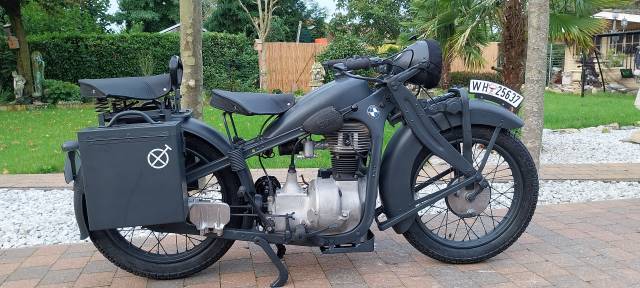
1936 | BMW R 4
R4

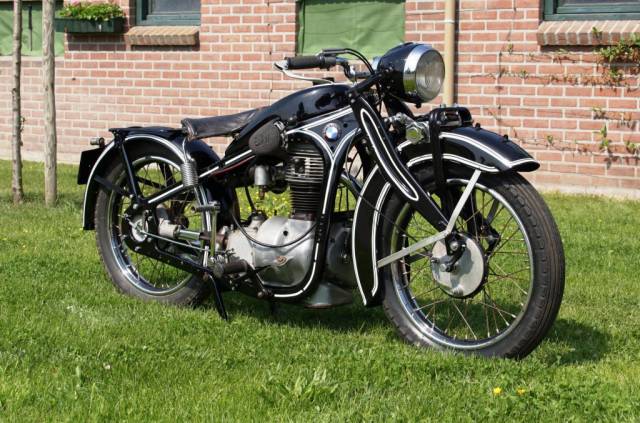
1934 | BMW R 4
BMW 400cc R4 year 1934 matching numbers very rare find out of old dutch collection

Create search alert
Let yourself be notified as soon as a listing is published that matches your search filters.
BMW R 4 Classic Motorbikes: Prices & Market Values
History of the BMW R 4
BMW introduced the R 4 in 1932 as an evolution of its flat-twin motorcycle lineage, purpose-built to address the needs of everyday commuters and professional riders in the Weimar Republic. The aim was to create a motorcycle that was affordable, easy to maintain and resilient under harsh road conditions. Drawing from lessons learned with the earlier R 2 and R 11 models, the R 4 became a preferred choice for police and postal services, as well as private owners who prioritised function over luxury. Production lasted until 1937, with significant annual updates reflecting BMW’s response to feedback from both professional and civilian use.
Model History and Model Evolution
The BMW R 4 does not fit into a conventional model family with direct predecessors or successors but sits chronologically between the single-cylinder R 2 and the advanced R 5. Over its lifespan, the R 4 underwent five series (Serie 1 to Serie 5). Improvements included changes from hand-lever to foot-operated gear shifts (from the third series onwards), reinforced frames, improved suspension and updates to electrics and carburation. These annual revisions reflect BMW’s ongoing attempts to fine-tune real-world usability and reliability.
Highlights and Production Data
The R 4 introduced practicality to BMW’s product line, balancing ride comfort, ruggedness and cost for a diverse clientele—at a time when private transport needs were changing rapidly. Innovations included a pressed-steel frame, drive-shaft final drive, and early adoption of foot-shift gear change. The R 4’s robust construction made it popular with German police and postal services, who sought durable and consistently reliable machines.
Technical Data
Special Editions and Limited Production Models
Within the run of the R 4, BMW introduced minor technical updates with each series rather than officially badged 'special editions.' However, earlier versions with hand-shift gear levers (Serie 1 and 2) are seen among collectors as technically distinct, and later, heavily updated Serie 5 motorcycles with improved frames and foot-shifted gearboxes have particular historical interest.
Engine and Dynamics, Transmission and Handling
Powered by a 398cc single-cylinder engine, the R 4 provides linear, tractable acceleration suitable for mid-1930s road conditions and daily use scenarios. The shaft-driven rear wheel eliminates chain adjustments and is recognised for its clean and reliable operation. Suspension was relatively basic by post-war standards, but frame updates by the fifth series improved high-speed stability. Gear selection varies by series, with a transition from hand- to foot-operated gearboxes—a feature which, in later models, improved ease of use for modern riders. Braking performance is modest compared to later periods but well-suited to the bike’s weight and intended usage. All R 4 series have their enthusiasts: early Series 1 and 2 for historical accuracy, and the later Series 5 for their more usable foot-shift gearbox and reinforced chassis.
Design, Accessories, and Visual Details
The BMW R 4 features a distinctive pressed-steel frame, exposed flathead engine, and a minimalist approach to bodywork—a result of the practical focus of pre-war German design. Paintwork typically consisted of black with white pinstriping. Accessories such as classic Bosch headlamps, luggage racks and period correct saddles are common among surviving examples. No designer is typically credited, reflecting BMW’s focus at the time on engineering-driven rather than stylistic innovation.
Summary
The BMW R 4 holds a crucial position in BMW’s motorcycle history, bridging the gap between early experimental engineering and the more refined, post-war models. Its combination of shaft final drive, pressed-steel construction, and ongoing annual improvements exemplified BMW’s pragmatic approach in pre-war Germany. Today, the entire supply and demand for BMW motorcycles of this era in the classic market is focused on the R 4, reflecting its significance among collectors with a technical or historical interest in the evolution of daily motorcycles during the 1930s.