Stoewer Greif Junior classic cars for sale
Unusual among German prewar vehicles, the Stoewer Greif Junior combines practical engineering with a heritage rooted in Offroad sports and technical innovation—standing out as the only German production car of its time with an air-cooled engine. Discover more about this rare model below.
Résultats de la recherche
À l'heure actuelle, il n'y a pas d'annonces correspondant à votre recherche.
Create search alert
Let yourself be notified as soon as a listing is published that matches your search filters.
Create listing
Do you have a Stoewer Greif Junior that you want to sell? Then create a listing now.
Create listingStoewer Greif Junior listing references from Classic Trader
Below you will find listings related to your search that are no longer available on Classic Trader. Use this information to gain insight into availability, value trends, and current pricing for a "Stoewer Greif Junior" to make a more informed purchasing decision.
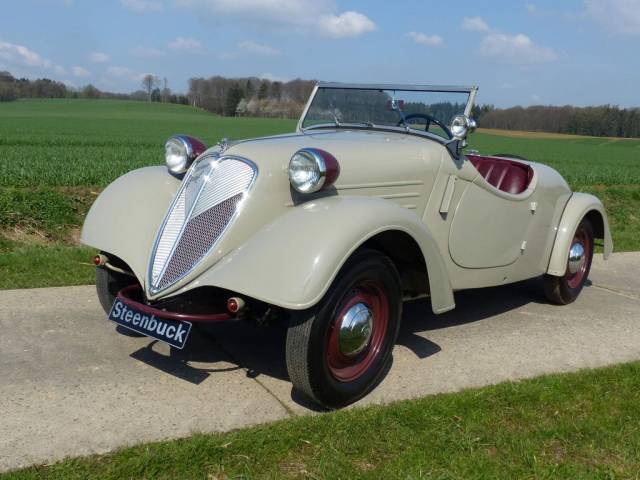
1937 | Stoewer Greif Junior
Extremly rare offroad roadster
Create search alert
Let yourself be notified as soon as a listing is published that matches your search filters.
Create listing
Do you have a Stoewer Greif Junior that you want to sell? Then create a listing now.
Create listingStoewer Greif Junior Classic Cars: Prices & Market Values
History of the Stoewer Greif Junior
The Stoewer-Werke, based in Stettin, began building automobiles as early as 1899. By the mid-1920s, Stoewer’s portfolio lacked a true mid-range model. In response, Stoewer acquired the 'Röhr Junior' model from the defunct Röhr-Werke. Originally a licensed version of a Tatra design, this vehicle would become the Stoewer Greif Junior. Notably, it was the only German passenger car of its era to feature an air-cooled engine—a concept long before Volkswagen would popularise it with the Käfer. The Greif Junior’s robust simplicity and practical approach set it apart in an era focused on technical innovation and competition.
Model History and Position within the Stoewer Range
The Stoewer Greif Junior directly succeeded the Röhr Junior after Stoewer adopted its production. The manufacturing relationship links the model to both Tatra’s technical ideas and Röhr’s vision for affordable, innovative vehicles. There was no genuine predecessor in Stoewer’s own line-up since the company lacked a true mid-class vehicle prior; the Greif Junior effectively filled this gap. Offroad motorsport prominence in the 1930s led to factory entries and specially modified versions achieving noteworthy successes in German competitions.
Highlights and Rarity of the Stoewer Greif Junior
The Stoewer Greif Junior holds a remarkable position as the only German passenger car of its time with an air-cooled engine. This engineering move set it apart and offered durability and ease of maintenance, especially valued in the practical, use-driven landscape of the 1930s. Its reputation for dependable, no-nonsense service was recognised both on and off the road, with strong results in German offroad racing thanks to dedicated works vehicles with reinforced drive technology.
Technical Data
Special Editions and Motorsport Variants
In the 1930s, Stoewer produced three specially engineered offroad roadsters of the Greif Junior, equipped with more powerful engines and adapted for competitive racing. These roadsters achieved victories and respectable placings in contemporary motorsport events, cementing the Greif Junior’s status among enthusiasts of historic offroad racing vehicles.
Weak Spots and Common Issues
Detailed information on recurring weak points or model-specific technical problems is not presently documented. Potential buyers should approach these rare vehicles with careful attention to originality, especially given their age and the possible modifications made for motorsport or utility use. Maintenance considerations should focus on engine cooling system integrity and checking drivetrain components for past repair quality.
Engine Performance, Transmission and Handling
The Greif Junior's air-cooled engine, inherited from its Tatra conception, delivered solid day-to-day reliability and excellent resilience in tough conditions—attributes vital for utility and offroad use. Specially developed offroad versions delivered increased power and enhanced drivetrain durability for competitive rallying and endurance events. Robustness rather than sporting performance was the focus, reflecting Stoewer’s philosophy of utility and low operating costs. Three unique offroad racing roadsters stand out among Greif Junior examples for their reinforced drive systems and powerful engines, tailored for motorsport demands.
Interior, Comfort, Exterior and Design Details
Aesthetically, the Stoewer Greif Junior carried pragmatic influences from its Tatra/Röhr engineering, with a functional, no-frills exterior. The utilitarian design facilitated both comfortable day-to-day use and straightforward adaptation for sport or utility purposes. Custom offroad versions received sportier bodywork and enhanced mechanical components, but original models remained true to a philosophy of practical efficiency. Special trim or accessories were rare, with most vehicles delivered in standard configurations favoured by local authorities and utility users.
Other Noteworthy Aspects
Today, surviving Stoewer Greif Junior vehicles are extremely rare, often seen at select vintage events where their unusual technical story and offroad successes attract knowledgeable collectors. They represent a tangible link to a period of German motoring characterised by innovation, cross-company cooperation, and the growing popularity of motorsport.
Summary
With its unique background as a rare example of prewar German automotive engineering influenced by both Tatra and Röhr, the Stoewer Greif Junior holds a special place among classic vehicles. Its air-cooled engine, connections to German motorsport, and rarity at current events underline its appeal to serious enthusiasts with an eye for engineering history and sporting pedigree.