AWS Shopper classic cars for sale
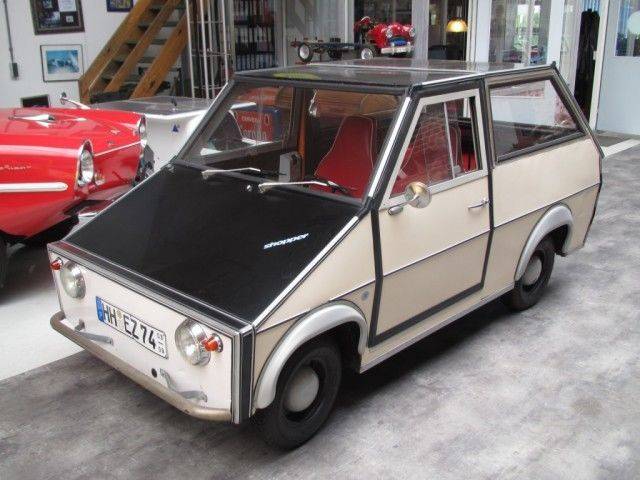
The AWS Shopper, produced in Berlin from 1973 to 1974, is a lightweight utilitarian car famed for its unique, hand-assembled construction and city-friendly proportions. Its practicality, simplicity, and distinctive appearance made it an interesting alternative in the compact car market of its time.
Search results
Currently, there are no matching listings for your search.
Create search alert
Let yourself be notified as soon as a listing is published that matches your search filters.
Create listing
Do you have a AWS Shopper that you want to sell? Then create a listing now.
Create listingAWS Shopper listing references from Classic Trader
Below you will find listings related to your search that are no longer available on Classic Trader. Use this information to gain insight into availability, value trends, and current pricing for a "AWS Shopper" to make a more informed purchasing decision.
1974 | AWS Shopper 250
Andere AWS Shopper
Create search alert
Let yourself be notified as soon as a listing is published that matches your search filters.
Create listing
Do you have a AWS Shopper that you want to sell? Then create a listing now.
Create listingHistory of the AWS Shopper
The AWS Shopper, developed by Walter Schätzle—an experienced automotive mechanic and former Borgward dealer—was first revealed at the 1970 Hannover Messe. Designed as a city car, the Shopper targeted urban drivers with a focus on efficient use of space, straightforward technology, and low operating costs. The vehicle’s minimalistic, functional design set it apart visually and reflected Schätzle’s belief in purposeful engineering over decorative details. Series production began in 1973 at Schätzle's Berlin-Rudow factory, taking advantage of local economic subsidies supporting Berlin industry. However, production was short-lived; a total of around 1,400–1,700 units were built before the company ceased operations in 1974 due to limited financial viability and challenges in maintaining product quality and cost efficiency. Schätzle left the company shortly before its bankruptcy.
Model History
The AWS Shopper emerged as an original concept without a direct predecessor. It incorporated several components from the Goggomobil T250, particularly the two-cylinder two-stroke engine, running gear, and floorpan. The main model produced was a closed two-seater, although a few prototype variants—including a delivery van with a flatbed and an open industrial cart—were built but never made it into series production. With no follow-up model after production ceased in 1974, the AWS Shopper remains a solitary chapter in German automotive history.
Highlights and Key Features
The AWS Shopper is distinguished by its modular skeleton frame made from aluminium square tubes and joints, covered with sheet metal and a plastic coating. The car’s construction method was so straightforward that individual body panels could be assembled by hand with basic tools—riveting, drilling, and hammering—eliminating the need for expensive production presses or paintwork. Its compact dimensions (3.07 metres long, 1.4 metres wide, 1.38 metres high, 1.8 metres wheelbase) and a kerb weight of only 415 kg allowed agile handling in city driving and made parking much easier. The minimalist 2+2 layout, with a large tailgate extending to the roof, optimised luggage access and utility. The AWS Shopper was commonly sold in a black and orange livery, which enhanced its street presence.
Technical Data
Special Editions and Collectible Models
While some prototypes such as a delivery van with a pick-up rear bed and an open industrial cart version were developed, only the standard closed two-seater entered production. No recognised limited-run special editions are documented; the rarity of all genuine AWS Shopper examples on the classic car market makes each surviving car unique.
Weak Spots and Common Issues
Available sources do not provide detailed weak spots for the AWS Shopper. However, the original information highlights an average build quality, which may result in inconsistent panel gaps, fit and finish issues, or accelerated wear of body components—especially since body panels were hand-assembled and not painted. Given the low production numbers and hand-built nature, buyers should carefully inspect the chassis joints and plastic-coated bodywork for signs of corrosion, fatigue, or earlier repairs. Mechanical parts sourced from the Goggomobil T250 may facilitate easier sourcing of engine and running gear components, but unique AWS-specific body and trim elements can be challenging to replace.
Engine and Performance, Transmission and Handling
The rear-mounted, two-cylinder two-stroke engine (13.6 hp) offers modest dynamic capabilities, prioritising efficiency and manoeuvrability over outright speed. The maximum velocity is limited to around 65 km/h, aligning with its intended urban usage. The four-speed manual gearbox drives the rear wheels, combined with the very low kerb weight for nimble city driving and simplicity in operation. Rigid mechanicals and basic suspension are derived from the Goggomobil, providing easy maintenance and familiar driving characteristics for microcar aficionados. - AWS Shopper Standard Two-Seater: 13.6 hp, Goggomobil-derived mechanicals, 415 kg weight, 65 km/h top speed. Its combination of practical design and rare presence make it noteworthy in the microcar scene.
Interior, Comfort, Exterior and Design
Designed for maximum utility, the AWS Shopper features a spartan cabin with seating for two, simple controls, and utilitarian finishes. The large, tall-opening tailgate enhances loading convenience and supports daily use. Black and orange became the characteristic paint scheme at launch, providing strong visual contrast. The basic structural framework, comprised of exposed aluminium sections and easily replaceable panels, signals its industrial approach to design. Accessories and special equipment were minimal—the focus remained on practical, cost-efficient motoring rather than luxury or customization.
Other Noteworthy Features
The AWS Shopper's construction process is exceptional: a single person could theoretically assemble a body panel using only a rivet gun, hammer, and drill. The deliberate omission of automotive paint and avoidance of expensive pressing tools reflect an engineering philosophy of reduction to the essentials. This approach set the AWS Shopper apart from contemporaries more reliant on complex and capital-intensive manufacturing methods.
Summary
The AWS Shopper embodies a unique chapter in German automotive culture, representing a radical experiment in minimalistic, urban-oriented vehicle design. Its hand-built aluminium frame, Goggomobil mechanics, and unorthodox production methods granted it a singular identity in the microcar class. With no successors and all AWS supply and demand focused solely on the Shopper, each extant example is both a testament to its era’s innovation and a rarity on today's classic car market.