Panhard Junior classic cars for sale
The Panhard Junior is a lightweight French roadster and cabriolet from the early 1950s, remarkable for its technical finesse, sporty looks, and unique construction history. Produced between 1952 and 1956, it captured the imagination of young drivers and remains a rare presence among classic cars today.
Search results
Currently, there are no matching listings for your search.
Create search alert
Let yourself be notified as soon as a listing is published that matches your search filters.
Create listing
Do you have a Panhard Junior that you want to sell? Then create a listing now.
Create listingPanhard Junior listing references from Classic Trader
Below you will find listings related to your search that are no longer available on Classic Trader. Use this information to gain insight into availability, value trends, and current pricing for a "Panhard Junior" to make a more informed purchasing decision.
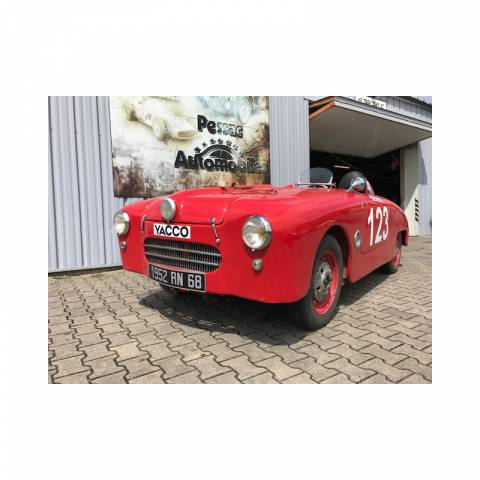
1952 | Panhard Junior X 87
PANHARD JUNIOR "COMPETITION"
Create search alert
Let yourself be notified as soon as a listing is published that matches your search filters.
Create listing
Do you have a Panhard Junior that you want to sell? Then create a listing now.
Create listingPanhard Junior Classic Cars: Prices & Market Values
History of the Panhard Junior
Founded in 1891, Panhard & Levassor were pioneers in automotive engineering, inventing the world's first series-produced car. By the 1950s, Panhard shifted from luxury vehicles to smaller, innovative cars, focusing on lightweight construction and efficient two-cylinder boxer engines. The Junior emerged in 1952, fired by demand for a compact, sporty roadster. Although initially intended for the US market at the request of importer Ferguson, the model remained a European affair after the order was cancelled. Nevertheless, Panhard pursued the project, giving young drivers in post-war France affordable access to the flair and fun of lightweight motoring. The car was penned by the ateliers of Di Rosa and assembled in Orléans. Over its run, the Junior was adapted from a roadster to include a convertible variant and moved from aluminium to steel coachwork, reflecting both economic necessity and design evolution. Production concluded in 1956 after 4,714 units, shortly before Panhard fused with Citroën.
Model Evolution and Variants
The Junior was based on the trustworthy Dyna X chassis, itself a milestone as Panhard's first post-war model. Early Juniors (1952-1954) carried the X86 and X86 Sprint designations, with 33 horsepower. The second series (1952-1956), coded X87 and X87 Sprint, benefited from engine upgrades delivering 40 to 42 horsepower. Alongside the original two-seater roadster, Panhard introduced a cabriolet version in 1953, offering more space thanks to a redesigned rear bench for three occupants and additional creature comforts like crank windows and larger doors. The chassis evolved from steel to aluminium late in production, a feature also used in the successor Dyna Z.
Special Features and Rarity of the Panhard Junior
A technical highlight is the use of a boxer twin-cylinder engine, unusually sophisticated in its class for the early 1950s. Compact dimensions, minimal weight, and spartan simplicity define the Junior's character—a car for those who prized agility and direct road feel over luxury. The luggage compartment accessed by folding the seat back illustrates a flair for pragmatic design. Notable as well is the adoption of steel over aluminium for bodywork, a reversal from early Dyna models. The Junior's place in French car culture is unique, inspiring retro designs decades later.
Technical Specifications
Special Editions and Collector's Variants
The X86 Sprint and X87 Sprint are notable Junior versions, distinguished by tuned engines and minor cosmetic enhancements. The 1953 Cabriolet offered unique three-person seating and additional comfort features, unlike the minimalist roadster. These subtypes attract attention from enthusiasts for their relative rarity and specific mechanical tweaks.
Weak Spots and Common Issues
No documented specific weak spots are supplied. Typically, for Panhard cars of this era, attention should be given to crankcase integrity, gearbox wear, and potential issues from infrequent use, as well as rust in steel-bodied examples. As original parts become increasingly rare, sourcing components can increase the total cost of ownership. Prospective buyers should inspect for correct specification attributions and chassis condition.
Engine, Drivetrain, and Driving Dynamics
The Junior is agile and responsive courtesy of its light construction, front-wheel-drive, and low-powered boxer twin. Period road testers admired its direct steering and road holding, with 33-42 PS sufficient for its low mass. The transition from the original Dyna X steel chassis to optional aluminium frames made a tangible difference for spirited driving. Gear changes are straightforward due to a proven manual transmission. While outpaced by modern cars, the Junior provides satisfying low-speed thrills on secondary roads, blending mechanical charm with post-war ingenuity. • X86 Roadster: 33 PS, steel body—ideal for purists. • X87 Sprint: Upgraded to 42 PS, rare and desirable among performance-minded collectors. • 1953 Cabriolet: Offers unique three-seat width and added comfort, a practical classic for touring.
Design, Interior, and Equipment
The Junior presents a distinctive post-war French design—compact, rounded, yet with a purposeful stance. Early examples wore minimalist trim, low windscreens, and exposed rear wheel arches. Cabriolet models incorporated more chrome, detailed interior appointments, and larger door openings, contributing to an airier cabin. Upholstery was simple but robust, and the dashboard is strictly functional. Little in the way of factory accessories or luxury was available; however, some cars have period-correct custom touches such as fog lamps or distinct paint finishes. Notably, bodywork evolved from steel to aluminium late in production, a detail closely watched by connoisseurs.
Other Features and Trivia
The access to the luggage compartment by folding down the rear seat back is a clever nod to maximizing space in the small cabin. Period advertising often targeted the car to younger drivers hungry for affordable style. The Junior's development, sparked by a US importer but ultimately kept in France, is a curious footnote in automotive history. Its DNA—affordable, technically progressive, delightfully unconventional—survived in spirit in later retro-inspired cars such as the Nissan Figaro.
Summary
Panhard Junior models stand out as lightweight, agile, and efficiently engineered examples of French motoring from the 1950s. Their distinctive styling, innovative use of chassis materials, and small-batch production place them among the more intriguing discoveries for classic car enthusiasts looking beyond mainstream European marques.