Tempo Hanseat classic cars for sale
The Tempo Hanseat stands out as a compact and highly distinctive three-wheeled light commercial vehicle, especially valued among collectors who appreciate functional design and robust engineering typical of post-war German utility vehicles.
Suchergebnisse
Zur Zeit sind keine passenden Inserate zu Ihrer Suche veröffentlicht.
Create search alert
Let yourself be notified as soon as a listing is published that matches your search filters.
Create listing
Do you have a Tempo Hanseat that you want to sell? Then create a listing now.
Create listingTempo Hanseat listing references from Classic Trader
Below you will find listings related to your search that are no longer available on Classic Trader. Use this information to gain insight into availability, value trends, and current pricing for a "Tempo Hanseat" to make a more informed purchasing decision.
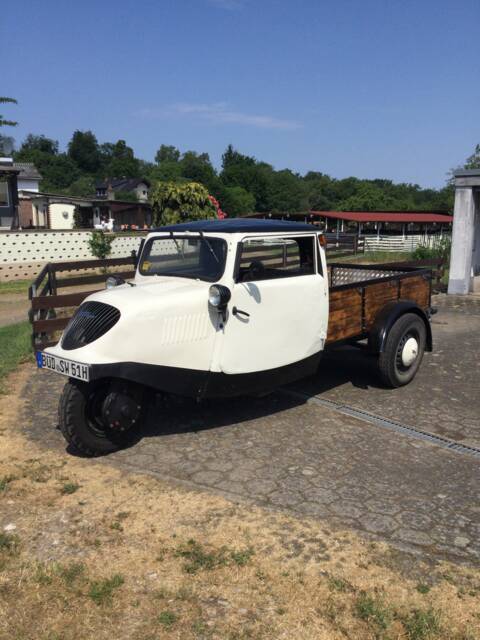
1951 | Tempo Hanseat
Create search alert
Let yourself be notified as soon as a listing is published that matches your search filters.
Create listing
Do you have a Tempo Hanseat that you want to sell? Then create a listing now.
Create listingTempo Hanseat Classic Cars: Prices & Market Values
History of the Tempo Hanseat
The Tempo Hanseat can trace its roots back to the practical post-war years in Germany, where affordable transportation and efficient utility vehicles were in high demand. Produced by Vidal & Sohn Tempo-Werke GmbH, the Hanseat was conceived as a versatile solution for small businesses, craftspeople and delivery services navigating urban environments and narrow country lanes in the 1950s and 1960s. The three-wheeled setup offered significant advantages in terms of manoeuvrability and operational economy, which aligned perfectly with the economic constraints and infrastructure of the era.
Model History of the Tempo Hanseat
Building upon Tempo’s earlier tricycle commercial vehicle designs, the Hanseat largely replaced the Tempo Front and related models. Production ran throughout the 1950s and into the early 1960s, with continuous improvements in loading capacity and reliability. While there is no direct successor from Tempo after the Hanseat, the concept was later revisited by other manufacturers in similar light utility formats. The Hanseat itself was available primarily as a pick-up or panel van, and often adapted to specific customer requirements due to its modular construction.
Highlights of the Tempo Hanseat
The Hanseat’s unique three-wheel configuration, rear-wheel drive via a simple chain or shaft mechanism, and instantly recognisable forward-control cab place it in a class of its own. Its reputation for remarkable durability and serviceability ensured a long service life despite often intensive commercial use. The Hanseat is currently the only Tempo model of its type listed on Classic Trader, representing 100% of both supply and demand statistics for the make. Its distinctiveness in the collector community remains unchallenged due to its exclusivity and rarity outside central Europe.
Technical Data – Tempo Hanseat
Special Editions and Collectible Models
Throughout its production span, the Hanseat was primarily offered in standard pick-up and panel van body styles, occasionally tailored for local delivery, municipal services or agricultural work. Factory-produced special editions were rare, but some coachbuilders created bespoke bodies for specific customers, resulting in a handful of highly individual one-off configurations prized by collectors.
Engine, Performance, Transmission and Handling
With its relatively low-powered engine, the Hanseat focused on rugged dependability rather than outright speed. Its three-wheel design ensured an exceptionally tight turning radius, highly practical for congested city streets and alleyways. The basic suspension and chassis setup was intended for resilience over comfort, suiting the tough working conditions many vehicles endured. Braking and handling characteristics require adjustment for modern drivers, especially in laden conditions or on uneven roads. Owners appreciate the simplicity of mechanical components, making restoration work within reach for many hobby mechanics. The Hanseat itself is the standout model in Tempo’s roster, with all technical variants following a similar mechanical template—typical are four-stroke petrol engines with around 12-20 horsepower, three-speed manual transmissions, and payload capacities between 500 and 750 kg.
Interior, Comfort, Exterior and Design
Interior appointments are extremely utilitarian, with early examples featuring sparse instrumentation, minimal soundproofing, and basic bench seating. The forward-control cabin maximises loading space, a key factor in its commercial utility. Externally, the compact proportions, distinctive single front wheel, and flat windshield give the Hanseat a recognizable silhouette, particularly in period-typical livery or paint. Most vehicles retained original factory colours—greys, blues, or greens—though individual businesses often commissioned custom painting or signwriting. Accessories ranged from weather protection for the load bed to additional lighting or mirrors. Early models may have had wooden elements in the load area, while later examples favoured metal assemblies.
Summary
The Tempo Hanseat occupies a unique place in the history of light commercial vehicles and classic motoring. Its three-wheeled architecture, robust engineering, and adaptability made it indispensable for small businesses in mid-20th-century Germany. Today, remaining examples are highly individual collectibles, rarely encountered outside specialist circles, ensuring their ongoing appeal for dedicated classic commercial vehicle enthusiasts.