- Car
- Eunos (0 offers)
Buy Eunos Classic Cars
Eunos was Mazda’s premium, driver-focused badge for Japan and, uniquely, an officially sold nameplate in Australia from 1992 to 1996. Today it covers everything from the cult MX-5-based Roadster to the rare Cosmo, making it a sharp choice for collectors and keen drivers alike.
Search results
Currently, there are no matching listings for your search.
Create search alert
Let yourself be notified as soon as a listing is published that matches your search filters.
Eunos listing references from Classic Trader
Below you will find listings related to your search that are no longer available on Classic Trader. Use this information to gain insight into availability, value trends, and current pricing for a "Eunos" to make a more informed purchasing decision.
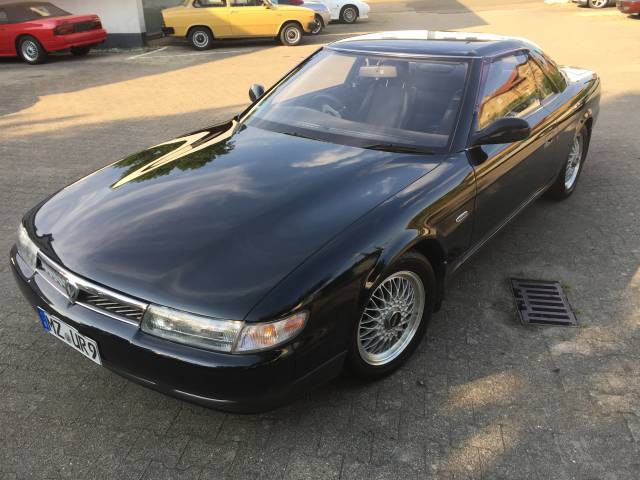
1993 | Eunos Cosmo SX 20B
3 Scheiben Wankel; 53500km; RHD

Create search alert
Let yourself be notified as soon as a listing is published that matches your search filters.
History
Eunos was Mazda’s answer to the late-1980s Japanese premium boom: a sub-brand created to sell cars that felt a little more stylish, a little more exclusive, and a lot more driver-focused than the mainstream badge. Launched in 1989, it sat alongside Mazda’s other short-lived nameplates and represented a period when Japanese manufacturers were experimenting with brand identity in the same way European marques had done for decades. Eunos was not simply a trim package or a marketing sticker. It was a fully fledged retail identity with its own showroom experience, its own model mix, and a clear promise: more character, more equipment, and more driving enjoyment.
For Australian buyers, Eunos has an important extra layer of relevance. Unlike many JDM-only badges that never officially reached local showrooms, Eunos was officially sold in Australia from 1992 to 1996. That matters because it gives the brand a local heritage, not just an import story. Australian-delivered Eunos cars sit in an interesting space today: part Mazda family, part niche premium experiment, and part collector curiosity. They also make sense in a country that drives on the left. Right-hand drive is a natural fit here, which makes Japanese domestic market cars easier to live with than in left-hand-drive regions.
The model line-up was short but memorable. The Eunos Roadster is the best known name, and in Japan it was the original NA-generation MX-5/Miata. The Eunos Cosmo was the halo car: a luxury grand tourer with one of Mazda’s most ambitious rotary engines, including the famous triple-rotor 20B. The Eunos Presso was Mazda’s compact, stylish coupe sold in other markets as the MX-3, while the Eunos 500 brought the badge into the mid-size executive segment. Together, they show the ambition of the era: light sports cars, boutique coupes, and high-tech flagships under one premium umbrella.
The brand lasted only until 1996, when Mazda dismantled its multi-brand strategy after the Japanese economic bubble burst and the costs of maintaining multiple dealer networks became too high. But the short life span is part of the appeal. Eunos cars have a very specific early-1990s Japanese flavour: playful, inventive, and willing to put driving feel ahead of the conservative logic that would dominate later years.
Highlights
Eunos stands out because it delivered genuine variety, not just one hero model. If you want the purest expression of the badge, the Roadster is the obvious entry point. If you want the strangest and most technically fascinating, the Cosmo is the one. If you want something more discreet, the Presso and Eunos 500 show how Mazda used the badge across different segments.
Eunos Roadster (NA) is the star attraction. Built from 1989 to 1997 and sold as the Mazda MX-5 in most export markets, it changed the modern sports car conversation. The early NA6CE used a 1,597cc B6ZE engine with around 120 bhp, while the later NA8C upgraded to a 1,839cc BP engine with about 130–133 bhp. Those numbers do not sound huge today, but the Roadster weighs roughly 940–980 kg, so the power-to-weight ratio is what gives it life. It also became one of the most successful sports cars ever built, with 431,506 NA cars produced in total.
Eunos Cosmo is the cult flagship. Built from 1990 to 1995, it came with either a 13B-REW twin-rotor or the remarkable 20B-REW triple-rotor twin-turbo, rated at 280 bhp. It was sold only with an automatic gearbox, which underlines its luxury GT mission rather than track-day intent. The Cosmo is famous not only for its rotary engineering but also for being packed with technology that was seriously ahead of its time.
Eunos Presso offers a different kind of charm. Sold from 1991 to 1998 and effectively equivalent to the Mazda MX-3, it is a compact coupe with sleek proportions and a strong early-1990s Japanese design identity. It is not as famous as the Roadster, but that is part of the appeal for buyers who want something rarer and more understated.
Eunos 500 rounds out the picture with a 1992–1996 production run and a premium mid-size format. It shows how Mazda tried to give Eunos a broader identity than just “sporty cars for enthusiasts”.
For Australian buyers, the big practical advantage is the right-hand-drive format. JDM Eunos cars feel native here, which reduces the pain usually associated with imports. Add Australia’s active enthusiast community, the club scene, and the ongoing appeal of late-20th-century Japanese cars, and Eunos becomes a very logical niche to explore.
Technical Data
Market Overview & Buying Tips
The Australian Eunos market is small, but that is exactly why it is interesting. You are not dealing with a broad, generic used-car pool. You are dealing with a niche that mixes officially delivered Australian cars, later JDM imports, and enthusiast-owned examples that have often passed through club hands. In practice, the market is strongest for the Roadster, with the Cosmo sitting at the rare end, and the Presso and Eunos 500 appearing only occasionally.
Pricing depends heavily on specification, originality, and rust condition. As a broad guide in Australia, a rough Eunos Roadster project car might start around A$5,000–A$10,000, while tidy drivers often sit between A$15,000 and A$30,000 depending on engine, body condition, and service history. Clean special editions can move well beyond that, particularly if they are original, low-kilometre, and rust-free. Exceptional cars with strong provenance can push into A$35,000+ territory. For the Cosmo, the market is more volatile because supply is so thin; imported examples can vary wildly depending on authenticity, condition, and whether a specialist has inspected the rotary and electronics.
Australian buyers should think in total landed cost if importing. If you are sourcing from Japan, the final figure usually includes the purchase price, Japanese export paperwork, inland transport, shipping, marine insurance, import approval, quarantine, customs clearance, GST, compliance work, and state registration. For SEVS-eligible vehicles, the import pathway can be more straightforward, but it still adds meaningful cost. On top of that, every state or territory has its own registration process, and many require a roadworthy certificate or equivalent inspection before plates can be issued. That means the bargain price you saw online is rarely the full story.
Because Australia drives on the left, Eunos is easier to enjoy here than in many other markets. A right-hand-drive Roadster or Cosmo feels normal in traffic, and that helps resale value too. The bigger question is not “can I live with it?” but “which example is worth buying?”
For the Eunos Roadster, look for rust first. The known trouble spots are the sills, rear wheel arches, floor pans, and front subframe mounts. Check the underside carefully and do not trust cosmetic paint alone. Rust is the difference between a smart purchase and an expensive restoration. Also inspect the boot area and the seams around the wheel wells, because moisture can hide in places that look fine from above.
Mechanical checks matter just as much. Early 1.6-litre cars from 1989 to 1991 can suffer from the crankshaft pulley issue, so confirm whether it has been addressed. The Roadster is an interference engine, so the timing belt must be changed every 100,000 km or every 5–6 years. If there is no proof, assume it needs doing. A neglected belt job can turn a small service item into a major repair.
Special editions deserve attention. Cars such as V-Special, S-Special, RS Limited and J-Limited can command a premium, especially if the equipment is intact. Bilstein suspension, Torsen limited-slip differentials, unique colours such as Sunburst Yellow, and original trim all add value. In Australia, these editions are often snapped up by MX-5 and Eunos club members, so a good one may not stay on the market long.
For the Cosmo, prioritise expertise. Rotary engines are not forgiving of vague maintenance. Check for evidence of proper servicing, cooling-system health, and a knowledgeable workshop history. The 20B triple-rotor is the headline feature, but the electronics and automatic transmission matter just as much. Because the Cosmo was only sold with an automatic gearbox, smooth shifting and clean operation are essential.
The Australian auction scene is another good place to watch. Houses such as Shannons, Lloyds, and Grays regularly surface Japanese classics, enthusiast cars, and project vehicles. A strong auction result can help you understand where the market is heading, especially for clean Roadsters and unusual special editions. If you are buying privately, the same logic applies: compare asking prices with recent auction outcomes rather than just classifieds.
Finally, join the community before you buy. Australia has a strong MX-5 and Eunos club scene, and that network is valuable for parts leads, workshop recommendations, and model-specific advice. In a niche market, community knowledge is worth real money.
Driving Feel
The Eunos Roadster is easy to understand the moment you sit in it. The seating position is low, the wheel is close, the pedals are neatly spaced, and the cabin is arranged around the driver rather than around a screen or a long list of features. It feels small in a good way. You do not just operate it; you wear it.
On the road, the Roadster’s appeal is less about raw speed and more about response. The light body means the engine does not need huge power to feel eager. The 1.6-litre NA6CE has enough urgency to keep the car lively, while the 1.8-litre NA8C adds a little more flexibility and punch. Either way, the throttle response, steering accuracy, and chassis balance are what make the car memorable. It changes direction with very little effort, and the suspension has enough compliance to stay composed on ordinary Australian roads rather than only on smooth tarmac.
That is one reason the Roadster became such a lasting favourite. It delivers a genuine sports-car experience at sensible speeds. You do not need to be attacking a track to enjoy it. A well-kept Roadster is just as entertaining on a coastal run, a weekend breakfast drive, or a twisty country road as it is on a circuit. The car is forgiving, but not dull. It invites you to drive better.
The Cosmo is the opposite sort of experience: smooth, luxurious, and unusual. The 20B triple-rotor has a refined, almost turbine-like character that is very different from a piston engine. There is a sense of effortlessness in the way it delivers power, and the automatic gearbox suits the grand touring brief. Where the Roadster is about lightness and precision, the Cosmo is about long-distance isolation and high-tech theatre. Even now, its blend of rotary sound, advanced cabin equipment, and early-1990s luxury makes it feel special.
The Presso sits somewhere in between. It is not as dramatic as the Roadster or as technically wild as the Cosmo, but it has a tidy, nimble feel that suits city use and weekend cruising. Buyers often underestimate it because it is less famous, yet that can make it an appealing choice for someone who wants a rarer Mazda-family coupe with Eunos cachet.
Design
Eunos design language is best understood as Japanese restraint mixed with early-1990s optimism. These cars were not shouting for attention in the way some contemporaries did. Instead, they relied on clean shapes, quality detailing, and proportions that looked right from every angle.
The Roadster is the purest example. Its long bonnet, short rear deck, pop-up headlights, and compact cabin create a classic roadster silhouette that still looks right today. The styling was intentionally simple, but it was never bland. Every line serves the car’s purpose. It is low, compact, and honest. That is a big part of why it has aged so well. Even now, it looks like a car built for driving rather than image.
The Cosmo is far more dramatic. It is a luxury coupe with a sleek fastback profile and a strong sense of occasion. The dashboard, digital displays, and integrated navigation system made it a showcase for Mazda’s ambitions. In period, it looked like a car from the future. Today, it looks like a confident artefact from a time when Japanese manufacturers were willing to take design and technology risks.
The Presso has a sharper, more compact coupe look, with proportions that feel youthful and slightly futuristic for its era. It shares the same basic design era as the Roadster and Cosmo, but it interprets Eunos style in a more affordable, urban way. The Eunos 500, meanwhile, is more formal and mature, showing how the badge could move into executive-car territory without losing its premium identity.
Across the range, one common trait stands out: the cars were designed to feel special without becoming overdone. That is useful today because it keeps them recognisable and distinctive, but not dependent on fads.
Heritage
Eunos matters because it captures a very specific moment in Japanese automotive history. The late 1980s and early 1990s were an era of confidence, experimentation, and boundary-pushing. Mazda used Eunos to test how far it could go with premium branding, dedicated retail channels, and unusually ambitious cars. Some of that strategy was commercially short-lived, but the cars themselves outlived the marketing experiment.
The Roadster’s heritage is especially strong. It revived the idea of the light, simple, affordable sports car at a time when many manufacturers had abandoned it. That influence spread far beyond Mazda. The modern MX-5 lineage is now one of the most important stories in enthusiast motoring, and the Eunos Roadster sits at the beginning of that success. For Australian buyers, the connection is even more direct because the car was officially sold here through Eunos between 1992 and 1996 before being folded into Mazda Australia’s broader lineup.
The Cosmo carries a different kind of heritage. It represents the kind of technical ambition that only certain Japanese brands were willing to attempt in the early 1990s. A triple-rotor, twin-turbo, luxury grand tourer with automatic transmission was never going to be a mass-market proposition. But it shows the depth of Mazda’s engineering confidence and remains one of the most fascinating Japanese cars of its era.
The Presso and Eunos 500 are important because they prove the badge was not just about one icon. Mazda tried to build a whole premium family around Eunos, with coupes and sedans as well as sports cars. That broader vision is part of the charm for collectors now: you can trace a whole design and brand philosophy through the range.
In Australia, Eunos also has a second life through the enthusiast scene. Club ownership keeps knowledge alive, parts are shared, and local specialists understand the cars far better than a general workshop might. That support network is crucial for longevity. It also means a good Eunos can remain a usable classic rather than a garage ornament.
If you buy one today, you are buying into more than a badge. You are buying into a moment when Mazda tried to do things differently, and in some cases brilliantly.
Summary
Eunos is one of those marques that feels small on paper and big in reality. The name lasted only from 1989 to 1996, but it produced cars that still matter: the Roadster, the Cosmo, the Presso, and the Eunos 500. Each one reflects a different side of Mazda’s ambition, from lightweight sports car purity to rotary-powered luxury excess.
For Australian buyers, the brand is especially attractive because it was officially sold here from 1992 to 1996 and because right-hand drive makes JDM ownership more practical. Whether you are shopping locally, watching Shannons or Lloyds auctions, or calculating the full cost of importing from Japan under SEVS, Eunos offers something rare: a classic badge with genuine driver appeal and a strong enthusiast following.
If you are after a Roadster, buy on condition, not on hope. If you are after a Cosmo, buy with specialist help. If you want a less obvious choice, the Presso and Eunos 500 reward patience. In every case, the best cars are the ones with clean histories, solid rust protection, and documented maintenance.
Find the right Eunos, and you get more than a classic car. You get a piece of Japanese premium history with real usability, real character, and real collector appeal.