- Car
- Alfa Romeo
- Alfa Romeo TZ (1 offer)
Alfa Romeo TZ Classic Cars for Sale
The Alfa Romeo TZ is a racing car with road legality, built from 1963 to 1967, known for its tubular chassis, Zagato bodywork, and advanced engineering. With a featherweight structure and a twin-cam engine, the TZ achieved notable motorsport performances and remains highly sought-after among classic Alfa Romeos.
Search results
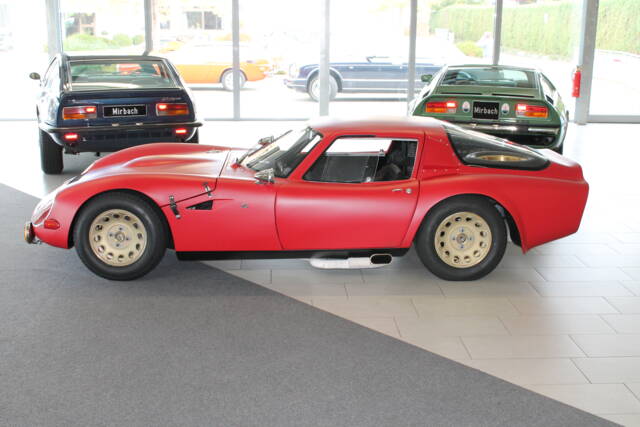
1965 | Alfa Romeo TZ 2
Tubolare Zagato II

Alfa Romeo TZ Classic Cars: Prices & Market Values
The History of the Alfa Romeo TZ
The Alfa Romeo TZ, launched at the 1962 Turin Auto Show, represents a high point in 1960s Italian motorsport engineering. Designed as a street-legal racing car, the 'TZ' designation comes from 'Tubolare Zagato'—referencing its innovative tubular spaceframe and the design house Zagato, renowned for their unique and aerodynamic bodies. Originally conceived to succeed the Giulietta SZ, the TZ incorporated lightweight construction and fresh aerodynamic thinking. Its flowing, rounded nose and distinctive cut-off rear recall early Ferrari influences, offering both style and performance. The collaboration with Zagato resulted in a car that quickly built a strong reputation on tracks, despite some technical setbacks during races. Over four production years, the TZ solidified its legacy as a foundation for subsequent Alfa competition vehicles.
Model History of the Alfa Romeo TZ Series
The Giulia TZ debuted in 1963, following in the footsteps of the Giulietta SZ. Initially called the 'Giulia TZ 1', it stood out for its featherweight 660 kg curb weight and advanced engineering. Production ran until 1965 with 102 units built. The refined TZ2 arrived in its final production year, 1967, bringing improved chassis dynamics, a new fiberglass body, reduced weight (620 kg), and an updated 165 PS engine. Only 12 examples of the TZ2 were made. Motorsport operations for Alfa Romeo transitioned to Autodelta from 1964 onward, overlapping with the development of the Giulia GTA. Although the GTA followed as Alfa Romeo’s main competition car, it was not a direct successor to the TZ. In 2011, the historical "TZ" designation was revived for the limited-run TZ3.
Highlights and Notable Features of the Alfa Romeo TZ
Lightweight construction set the TZ apart, achieving a dry weight as low as 660 kg thanks to its tubular frame, designed for agility and speed. The advanced twin-cam engine, coupled with independent suspension and disc brakes on both axles, provided superior handling and driving precision, vital for competitive motorsport use. Aerodynamic considerations, especially the sharply cut-off "Kamm tail," enhanced stability at high speed and gave the TZ an unmistakable silhouette. The model’s exclusivity and racing focus positioned it as an engineering showcase within Alfa Romeo’s history.
Technical Data
Special Editions and Collectible Models
Two main versions define collectability: the original TZ1 (1963–1965, 102 units) and the refined TZ2 (1965–1967, 12 units), the latter featuring a lighter fiberglass body and a more powerful engine. The 2011 TZ3 revival by Zagato is a modern homage noteworthy for collectors, though technically unrelated to the original series.
Engine and Performance, Transmission and Handling
The TZ’s double overhead camshaft four-cylinder offered strong output for its displacement, with racing versions extracting significant additional power. The car’s featherweight tubular frame, all-around disc brakes, and four-wheel independent suspension gave it exceptionally sharp handling and braking, ensuring competitive results on the circuit. Critical improvements in the TZ2, such as further weight reduction, upgraded engine, and stiffer suspension, led to speed and stability increases, allowing a top speed above 245 km/h. The chassis provided the necessary rigidity for high-speed track cornering and reliability improvements over its predecessor. - TZ1 (1963–1965): 1.6-litre DOHC, 112–160 PS, 660 kg, top speed >215 km/h.
- TZ2 (1965–1967): 1.6-litre tuned, 165 PS, 620 kg fiberglass body, top speed >245 km/h.
Interior, Comfort, Exterior and Design
Zagato’s craftsmanship is immediately evident: the TZ’s bodywork prioritises both aerodynamic efficiency and distinctive visual identity. The car’s flattened profile and pronounced rear ‘Kamm tail’ optimise airflow, while the front features subtly inset headlamps. Interior amenities are sparse and purposeful, focused on minimalism for weight saving and driver focus. Materials are typical for lightweight competition vehicles: thinly padded seating, aluminium surfaces, and stripped trim. Accessories are virtually non-existent, as the design intention was pure racing functionality.
Further Features and Context
The TZ name’s revival in the 2011 Zagato TZ3 reflects ongoing fascination with the model’s innovation and motorsport impact. The original TZ series remains influential in the development philosophy of subsequent Alfa Romeo competition cars.
Summary
The Alfa Romeo TZ series captures a critical period in Italian motorsport history, balancing advanced engineering, progressive aerodynamics, and Zagato styling. With ultra-low production numbers and racing pedigree, the TZ remains a standout for connoisseurs seeking authentic, lightweight 1960s Alfa Romeos.