- Car
- Ahrens-Fox (0 offers)
Buy Ahrens-Fox classic cars
Ahrens-Fox sits in one of the smallest collector niches on the market: giant American fire engines with exposed piston pumps, polished pressure spheres and real museum stature. For Australian buyers, the marque carries an extra hook because New South Wales imported one of its own in 1929, while today every serious purchase still depends on US auction comps, import approval and state registration reality.
Search results
Currently, there are no matching listings for your search.
Create search alert
Let yourself be notified as soon as a listing is published that matches your search filters.
Create listing
Do you have a Ahrens-Fox that you want to sell? Then create a listing now.
Create listingAhrens-Fox listing references from Classic Trader
Below you will find listings related to your search that are no longer available on Classic Trader. Use this information to gain insight into availability, value trends, and current pricing for a "Ahrens-Fox" to make a more informed purchasing decision.
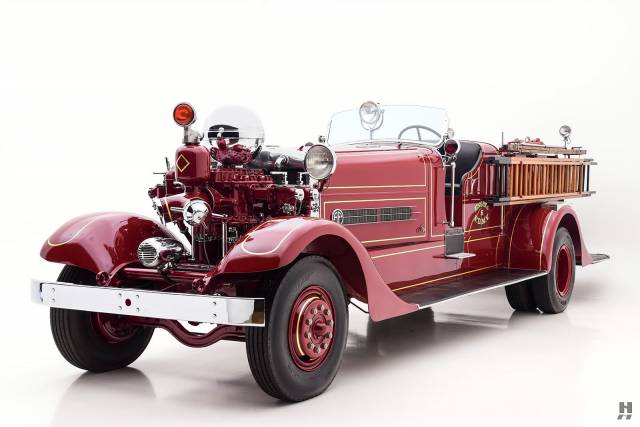
1936 | Ahrens-Fox BT Firetruck
Ahrens Fox BT
Create search alert
Let yourself be notified as soon as a listing is published that matches your search filters.
Create listing
Do you have a Ahrens-Fox that you want to sell? Then create a listing now.
Create listingHistory & Heritage
Ahrens-Fox was never a normal car brand, and that is the first thing an Australian buyer should understand. This was a Cincinnati fire-apparatus manufacturer, founded in 1910 by John P. Ahrens and Charles H. Fox, best known for building some of the most extravagant, best-engineered and most recognisable motorised fire engines of the pre-war era. On a marketplace classified as cars, an Ahrens-Fox listing is really shorthand for something rarer and stranger: a historic, road-registerable fire engine, or in the most elusive case, the near-mythical 1913 E-C Battalion Roadster.
The roots of the company reach back into Cincinnati’s nineteenth-century fire-engine tradition. Before the Ahrens-Fox name itself appeared, the Ahrens family was already tied to fire-engine manufacture through the legacy of Alexander B. Latta, Chris Ahrens’ apprenticeship and the earlier Ahrens Fire Engine Company. After the split from the American LaFrance orbit and the 1910 reorganisation, Ahrens-Fox moved decisively into petrol-powered apparatus.
Its first motorised fire engine appeared in 1911, and the company quickly developed a reputation for building apparatus that would cost more than rivals, but also work harder. In an era when pumping power and reliability could decide whether an urban fire stayed contained or became catastrophic, that mattered. Contemporary accounts and later collector literature repeatedly return to one point: Ahrens-Fox machines were bought by departments that wanted the best hardware they could afford.
The most unusual early chapter is the 1913 E-C Battalion Roadster. This was Ahrens-Fox’s only real venture into automobile production: a six-cylinder chief’s car with a 44hp rating, four-speed gearbox, a claimed 50mph top speed and a small rear utility section for brigade gear. Only six were built. That makes it the most elusive Ahrens-Fox of all, but the brand’s true identity was forged not by roadsters, but by pumpers.
Those pumpers are what made Ahrens-Fox famous. Early machines such as the Model J-M-3 introduced the visual vocabulary collectors now associate with the make: the long bonnet, huge lamps, the towering exposed piston pump mounted ahead of the radiator, and the polished spherical air chamber above it. That sphere was not there for decoration. It smoothed water pulsation so the hose delivered a steadier stream and reduced the dangerous surging that earlier systems could create.
By the mid-1920s, Ahrens-Fox had become one of the defining names in premium American fire apparatus. The N-S-4 is one of the best collector references from that period. RM Sotheby’s records describe it as a 1,000gpm pumper, often with a quad-pump arrangement, and the model code itself helps explain the truck: N for engine family, S for shaft drive, and 4 for the booster-tank configuration. Restored examples combine giant six-cylinder engines, polished brass and nickel, wooden ladders, button-tufted upholstery and a front elevation unlike anything else on the road.
The 1930 Model V sits in a slightly more approachable part of the Ahrens-Fox world. It still carries the unmistakable Fox look, but in a 500gpm format, commonly with the YXC-3 Hercules six-cylinder engine and Fuller four-speed gearbox. If the BT is the marque’s grand statement, the Model V is the version that lets more private collectors, local museums and specialist enthusiasts realistically participate.
There were also support trucks such as the P-S-14 hose and equipment truck, which matter because they show the company was more than one dramatic pump design. RM Sotheby’s documented the P-S-14’s 1,120ci T-head inline-six, and the truck remains a useful benchmark for buyers considering non-pumper Foxes.
At the top sits the BT. Produced from 1935 to 1939, it used a company-built 1,140ci six-cylinder engine and could deliver 1,250 gallons per minute at 120psi. Collector references suggest only eight or nine were built, with roughly six survivors known. That scarcity, plus the size and spectacle of the BT, makes it the halo Ahrens-Fox for many collectors.
Australia gives the Ahrens-Fox story a special local angle. In December 1928, the NSW Fire Brigades ordered a P-series Ahrens-Fox chassis to replace the ageing Shand Mason steamer known as Big Ben. Delivered to Sydney in May 1929, bodied locally and trialled at Woolloomooloo in August, it became the first and only Ahrens-Fox delivered to New South Wales. The preserved truck later entered the Museum of Fire collection and remains one of the best-known Ahrens-Foxes outside the United States. For Australian buyers, that matters. Ahrens-Fox is not just an imported curiosity here; it has a real local preservation chapter.
In total, more than 1,500 pieces of Ahrens-Fox apparatus were built before the original company disappeared, later leaving behind assets, parts records and a legacy that survives in both collector circles and the revived commercial brand name. For the collector market in 2026, five key models best define the make: E-C Battalion Roadster, J-M-3, N-S-4, Model V, and BT.
Highlights & Features
The reason buyers chase Ahrens-Fox is simple: almost nothing else looks, feels or presents itself the same way.
The biggest single highlight is the front-mounted piston pump. On a Fox, the pump is not hidden behind coachwork. It is the identity of the machine. The vertical pistons, polished metalwork and spherical air chamber turn the truck into a piece of industrial theatre. Even people with little knowledge of fire apparatus usually understand instantly that they are looking at something exceptional.
The second highlight is engineering seriousness. Bonhams described Ahrens-Fox powertrains as using dual ignition, duplicated systems and other redundancy measures because reliability under pressure mattered more than cost. That over-engineered mindset is part of what buyers still pay for. A good Ahrens-Fox does not feel like a decorative parade truck first and an engineering object second. It feels the other way around.
Third, the marque rewards buyers who learn the model codes. The letters and numbers are not random. They can indicate engine family, drive type, body type or pumping arrangement. That matters because many surviving trucks were modified in service, re-bodied, shortened, repainted or later restored with mixed-period components. On Ahrens-Fox, knowledge of nomenclature can be the difference between buying an authentic, well-documented machine and paying premium money for a plausible-looking recreation.
Fourth, the market is not one-dimensional. The E-C Battalion Roadster appeals to pure rarity collectors. The N-S-4 and J-M-3 are the brass-era statement pieces. The Model V gives you the classic Fox silhouette in a slightly more manageable package. The BT is the flagship: scarce, huge and market-defining.
For Australia there is a fifth attraction: local heritage resonance. The preserved NSW truck gives the marque an entry point into Australian fire-service history, and that changes how the brand reads here. It is easier to justify a Fox in an Australian collection when there is already a recognised local story, not just an imported one.
There are hard realities too. Ahrens-Fox ownership means space, freight, specialist knowledge and patience. The same factors that make the marque special also make it demanding. That is why the best buyers are usually museums, serious industrial-heritage collectors or private owners who are comfortable with slow, exacting projects.
Technical Data
Published Ahrens-Fox specifications are rarely as tidy as sports-car data because many trucks were custom-built for fire departments and later restored over several decades. Buyers should therefore treat catalogue figures as strong clues, then confirm identity against the actual vehicle, model plate, build records, pump tags and restoration file.
Market Overview & Buying Tips
The Australian-facing market for Ahrens-Fox is extremely thin. When this page was researched, the Classic Trader Ahrens-Fox category showed 0 offers. That is not a temporary inconvenience; it is the nature of the market. If you want one in Australia, you are usually shopping the United States and occasionally watching museums, specialist auctions or long-term private holdings.
Current price picture
The strongest recent public comp is Bring a Trailer, where a 1926 Ahrens-Fox M-X-4 Fire Truck sold in December 2024 for US$130,000. That truck had a 998ci inline-six, 750gpm pump assembly, three-speed manual gearbox, 15-foot wheelbase and overall length of 23 feet. It was restored, visually complete and titleable, which makes it a very relevant benchmark for a mid-size Fox that a serious collector could actually use and display.
Almost at the same time, Morphy Auctions sold a 1927 Ahrens-Fox MX-4 Triple Combination Pumping Fire Engine in December 2024 for US$126,000 including buyer’s premium. That is useful confirmation that the BaT result was not a one-off outlier.
Older public results still help map hierarchy. RM Sotheby’s sold a 1924 N-S-4 for US$82,500 in 2015, a 1930 Model V for US$60,500 in 2014 and a 1930 P-S-14 for US$93,500 in 2012. Those sales are older, but they illustrate how the market tends to stack up: smaller or less visually dramatic Foxes sit below the halo trucks, while the biggest, rarest machines command the strongest money.
At the top sits the BT. The Classic Valuer’s 2026 guide places the BT’s all-time public median at roughly £116,371, compared with about £25,594 for the Model V, £22,453 for the N-S-4 and £59,435 for the P-S-14. Those are not Australian transaction numbers, but they are still useful for relative ranking.
For Australian buyers, you then have to add freight, approval, port, quarantine, tax and registration costs. A six-figure US purchase can become a very different number by the time it is sitting legally in an Australian shed.
Importing into Australia: what matters most
1. Approval first, shipping second
Australia’s Department of Infrastructure is explicit: do not send the vehicle before obtaining the correct import approval. Under the Road Vehicle Standards Act, an approval is required before import, and the process now runs through ROVER. For older collector vehicles, the relevant pathway is typically the older vehicle concessional entry route.
2. Age helps, but does not solve everything
Department guidance says vehicles 25 years or older can qualify under the older-vehicle pathway. That is helpful for Ahrens-Fox because every original example is well beyond that threshold. But approval is only part of the job. State and territory registration authorities still decide whether the truck can be registered for road use.
3. Duty, GST and port costs
Australian Border Force guidance makes clear that imported vehicles can attract customs duty and 10% GST, plus storage, processing, wharf, broker and transport charges. In practice, the headline auction result is only the beginning. Quarantine cleaning, asbestos checks and heavy-vehicle transport can materially change the budget.
4. Left-hand drive and state rules
One of the biggest Australian value factors is RHD versus LHD. Some preserved Ahrens-Foxes were right-hand drive, which is a real plus here. Others are not. State rules differ, and while old left-hand-drive vehicles may be registrable under certain pathways, you should never assume import approval guarantees practical road registration. Western Australia’s guidance, for example, spells out separate licensing considerations for left-hand-drive vehicles. Similar caution applies elsewhere.
Why the NSW truck matters to Australian buyers
Australian collectors often ask whether an imported specialist vehicle has any local resonance. With Ahrens-Fox, the answer is yes. The 1929 NSW Fire Brigades truck gives the marque an Australian foothold. Museum of Fire research shows the chassis was ordered in December 1928, shipped from Ohio in February 1929, delivered to Sydney in May, then body-built locally and trialled at Woolloomooloo in August 1929.
The truck could pump more than 4,500 litres per minute at pressures up to 3,000kPa, and later proved itself in major Sydney fires. During the Goldsborough Mort wool store fire in 1935, it reportedly pumped water continuously for 144 hours. That sort of service history is exactly why the Ahrens-Fox name still resonates in preservation circles.
Inspection priorities
Start with identity and paperwork. On a Fox, the model designation, registration number, build records and restoration file matter enormously because trucks have often been rebuilt, altered or restored using parts from other vehicles. There is nothing automatically wrong with that, but the file must be honest.
Then inspect the pump. A polished pump assembly can make a truck look ready for demonstration when it is actually a static display piece. On at least one recent major sale, the seller stated the pump’s operating condition was unknown. If you want a live demonstrator for parades or museum events, unknown pump condition must be treated as a major cost risk.
Next, inspect the engine and ignition system. Bonhams highlighted duplicated and redundant systems as part of the Ahrens-Fox engineering brief. Today that means checking carburetion, magneto condition, cooling, oiling, wiring and whether the engine family matches the truck’s claimed model.
After that, examine the driveline, steering and brakes. These are huge, heavy machines. Worn steering boxes, tired brake systems, rear-end wear, gearbox issues and axle play are much more important than cosmetic flaws.
Bodywork deserves equal attention. A proper restoration may involve oak replacement, extensive sheet-metal reconstruction, leather trimming, gold leaf, period lighting, ladders and accurate equipment mounting. Big glossy paint hides a lot. Check the hose bed, running boards, pump mounts, ladder supports, timber structure, step plates and any steel where moisture can be trapped.
Finally, evaluate completeness. Hoses, nozzles, lanterns, bells, period tools, suction pipes and lighting equipment are not cheap decorative extras; on a truck like this, they are part of the vehicle’s value.
Parts and support
One advantage of Ahrens-Fox collecting is that support has not vanished entirely. The owner-led Ahrens-Fox Project remains useful for manuals, how-to material and parts discussion, and that matters if you are buying from Australia. You will almost certainly rely on US-based knowledge and contacts. Local support in Australia is more likely to come from museum-restoration circles, heavy-vehicle engineers and fire-service heritage networks than from ordinary classic-car workshops.
Driving Experience
Driving an Ahrens-Fox is less like taking a classic car out for a run and more like moving a preserved mechanical monument.
The first thing you notice is steering weight. The pump hardware and engine place enormous emphasis on the front axle, and the preserved NSW truck’s own oral history makes the point perfectly. Deputy Chief Officer J. E. Meeve later recalled that the steering was extremely heavy at low speed, and that once underway the whole machine could take on a rhythmic bounce that felt distinctly odd.
The second thing is the sound. A big Ahrens-Fox six has an industrial, deliberate beat that feels closer to plant machinery or marine power than to a passenger car. Add the exposed hardware, siren equipment and the long bonnet stretching away in front of you, and the experience becomes theatrical without trying.
The third thing is sheer presence. Even at walking speed through a showground or fire museum event, a Fox turns every movement into ceremony. Crowds do not glance at one and keep going. They stop.
There are obvious compromises. Braking is historic. Steering can be hard work. Road speed is secondary even when catalogues quote impressive figures. Some examples may be right-hand drive, which is ideal here. Others may not be. None of this is daily-driver territory.
But that is exactly the point. An Ahrens-Fox offers an experience that ordinary classics cannot: slow, mechanical grandeur with visible purpose in every component.
Design & Coachwork
From a design standpoint, Ahrens-Fox is one of the strongest names ever to appear in the collector-vehicle world.
The centrepiece is the pump face. Most makers would have hidden this equipment. Ahrens-Fox displayed it, polished it and made it the visual signature of the truck. The famous air chamber is one of those perfect industrial-design objects: simple, functional and so distinctive that it becomes sculpture.
Around it, the trucks combine long-bonnet American proportions with ceremonial detailing. The best restorations feature deep red paint, intricate gold striping, plated fittings, huge lamps, leather seating, varnished dash wood, period equipment and beautifully presented ladders and hose gear. Even buyers who do not normally collect commercial vehicles often respond to a good Fox because it feels intentionally composed, not just utilitarian.
The Model V is balanced and elegant, the N-S-4 has towering brass-era presence, and the BT reaches pure spectacle. The NSW example adds another layer because its chassis was American while the bodywork was completed locally, creating a subtle Australian chapter inside the broader design story.
Originality matters immensely. Correct paint shade, department lettering, right-spec lighting, proper pump details and believable equipment fitment can separate a museum-grade restoration from something merely glossy. On Ahrens-Fox, finish quality is part of authenticity, not an optional extra.
Museums, Service History & Cultural Weight
There is no racing narrative to sell here, and none is needed. Ahrens-Fox matters because of public-service history, industrial design and museum value.
In the United States, preserved Foxes are stars of fire museums, municipal heritage collections and collector sales because they embody a period when fire departments bought visible engineering prestige as well as pumping power. In Australia, the NSW truck gives that story a direct local expression. It was not just displayed; it worked, and its museum survival means Australian collectors can still see the marque in a local historical frame rather than only in imported auction catalogues.
That local connection also helps explain why the make can make sense here despite all the hurdles. Ahrens-Fox is not practical in any modern sense, but it offers craftsmanship, public history and total visual identity. That is enough for serious collectors.
Summary
If you want one of the most distinctive collector vehicles ever built, Ahrens-Fox delivers. The market is tiny, the buying process is serious and the best public 2024 comps still sit around US$130,000 and US$126,000 for restored M-X-4/MX-4 trucks, with the BT remaining the halo model.
For Australian buyers, the formula is clear: secure the import approval first, budget for GST, duty and logistics, check your state registration rules, verify whether the truck is RHD or LHD, and inspect identity, pump condition and completeness before you commit. Do that properly, and an Ahrens-Fox offers something few other collector vehicles can match: museum presence, engineering drama and a real link to Australian fire-service heritage.