- Automobile
- Moskwitsch
- Moskwitsch 400 (0 offerte)
Moskwitsch 400 classic cars for sale
Discover the Moskwitsch 400, a post-war Soviet classic inspired by German engineering tradition. This series symbolises a pivotal moment in automotive history, combining Russian resilience with proven technical concepts. Perfect for enthusiasts of unique historic vehicles and Eastern European engineering.
Risultati della ricerca
Attualmente non ci sono annunci corrispondenti alla tua ricerca.
Create search alert
Let yourself be notified as soon as a listing is published that matches your search filters.
Create listing
Do you have a Moskwitsch 400 that you want to sell? Then create a listing now.
Create listingMoskwitsch 400 listing references from Classic Trader
Below you will find listings related to your search that are no longer available on Classic Trader. Use this information to gain insight into availability, value trends, and current pricing for a "Moskwitsch 400" to make a more informed purchasing decision.
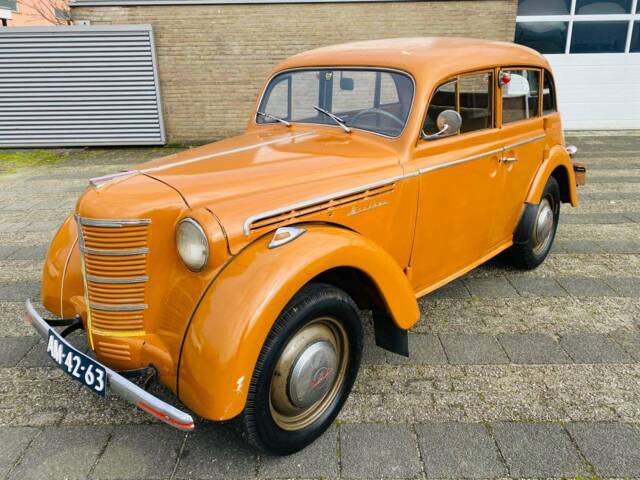
1952 | Moskwitsch 420
Opel Olympia Moskvitch 400 1952
Create search alert
Let yourself be notified as soon as a listing is published that matches your search filters.
Create listing
Do you have a Moskwitsch 400 that you want to sell? Then create a listing now.
Create listingMoskwitsch 400 Classic Cars: Prices & Market Values
History of Moskwitsch 400
The Moskwitsch 400 traces its origins to the immediate post-World War II era, representing one of the Soviet Union’s earliest attempts to produce a people’s car for post-war reconstruction. Production started in 1947 at the Moscow-based MZMA (Moskovsky Zavod Malolitrazhnykh Avtomobiley). The technical basis came from the Opel Kadett K38, whose design and tooling were acquired from Germany as reparations. This connection makes the Moskwitsch 400 a fascinating blend of German precision and Soviet pragmatism, reflecting the context of innovative resourcefulness after the war.
Model history
Introduced in 1947, the Moskwitsch 400 initially rolled off the production lines as the 400-420 sedan. Over subsequent years, derivatives including the 400-420A cabriolet and 400-422 estate expanded the appeal of the series. The direct successor, the Moskwitsch 401, brought moderate improvements in the early 1950s, such as a more robust engine. The 400 series itself evolved subtly during its run, but its core design remained largely unchanged throughout production.
Highlights of the Moskwitsch 400
The Moskwitsch 400 is notable for its historical roots and its role in Soviet automotive development. Key features include the adoption of Opel's K38 chassis and bodywork, mechanical resilience, and adaptability to the sometimes harsh driving conditions of Eastern Europe. For collectors, the 400 series is particularly attractive due to its direct lineage from a Western pre-war car, making it stand out among post-war Soviet vehicles.
Technical Data
Special Editions and Collectible Models
The 400-420A cabriolet stands out as a factory-built open-top variant, valued among aficionados for its rarity. Additionally, the 400-422 estate version, often used by small businesses and services, is considered collectible due to its relative scarcity compared to the sedan bodystyle.
Weak Spots and Common Issues
Due to its age and utilitarian origin, the Moskwitsch 400 can suffer from typical classic car issues such as corrosion on body panels and undercarriage. Mechanical wear in the engine, gearbox, and especially the suspension system is not uncommon. Sourcing genuine parts can require patience, although there is a dedicated community of Eastern European classic car specialists. Regular inspection of the electrical system and carburettor setup is recommended to ensure reliable running.
Engine and Performance, Transmission and Handling
The 1.1-litre engine allows for modest but dependable performance, with a top speed typically around 90 km/h. The rear-wheel-drive layout and robust construction cope well with unpaved roads—a necessity in its original markets. Handling is basic by modern standards, with a focus on durability rather than driving dynamics. Gear changes via the three-speed manual are deliberate, and the ride is characterised by soft suspension tuning tailored to cope with rough terrain. Popular choices include the standard 400-420 sedan and the convertible 400-420A, which combine historical significance with mechanical simplicity.
Interior, Comfort, Exterior and Design
Design-wise, the Moskwitsch 400 closely mimics the pre-war Opel Kadett, with rounded fenders, a split front grille, and modest chrome accents. Interior equipment is minimalistic: most cars feature basic instrumentation, a simple bench seat, and practical trim materials. Unique design elements include the metal-dash and the steering wheel inspired by late-1930s German cars. Some estate and convertible variants introduced subtle upholstery and body trims not seen on the base sedan, catering to specific market needs and climatic conditions.
Other relevant features
The Moskwitsch 400's engineering simplicity makes it comparatively straightforward to maintain for those with classic car experience. Club support in Russia and parts of Eastern Europe remains robust, improving the viability of restoration or regular use. Period accessories, including roof racks, radios, and bespoke toolkits, further enhance originality and usability.
Summary
The Moskwitsch 400 symbolises a unique chapter in automobile history, reflecting both post-war necessity and cross-cultural design synthesis. Robust, charmingly straightforward, and rich in history, it appeals to enthusiasts who appreciate its technical roots and utilitarian approach to classic motoring in a changing world.