Adler Diplomat classic cars for sale
The Adler Diplomat, built in Frankfurt from 1934 to 1938, marks the peak of Adler's innovation with its imposing six-cylinder engine, streamlined bodywork and remarkable luxury for its era. Offered as a saloon, pullman limousine, and rare cabriolet, it stands today as a symbol of German automotive excellence and exclusivity in pre-war classic cars.
Search results
Currently, there are no matching listings for your search.
Create search alert
Let yourself be notified as soon as a listing is published that matches your search filters.
Create listing
Do you have a Adler Diplomat that you want to sell? Then create a listing now.
Create listingAdler Diplomat listing references from Classic Trader
Below you will find listings related to your search that are no longer available on Classic Trader. Use this information to gain insight into availability, value trends, and current pricing for a "Adler Diplomat" to make a more informed purchasing decision.
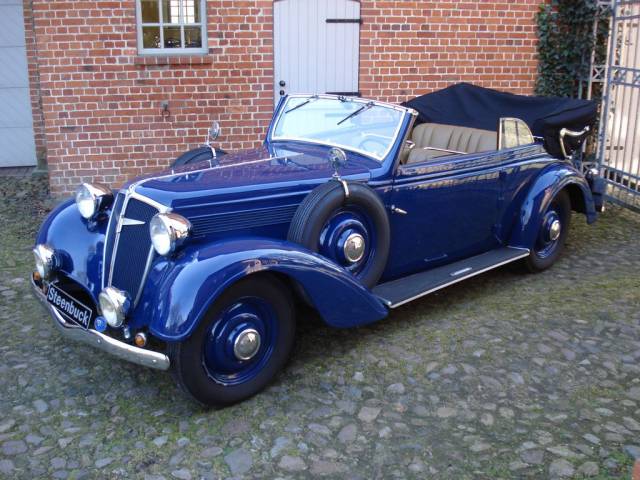
1935 | Adler Diplomat
A rare "Papler" creation

Create search alert
Let yourself be notified as soon as a listing is published that matches your search filters.
Create listing
Do you have a Adler Diplomat that you want to sell? Then create a listing now.
Create listingAdler Diplomat Classic Cars: Prices & Market Values
History of the Adler Diplomat
The Adler Diplomat debuted in March 1934 as a direct replacement for Adler's Standard 6 and, by extension, the Standard 8. Adler aimed to distance the new model from any notion of being 'standard', emphasising its premium status with a new name. While based on the final evolution of the Standard 6 chassis and technology, the Diplomat introduced subtle improvements, including a refined six-cylinder, 3.0-litre side-valve engine producing 60 PS. The introduction of a more streamlined body in 1935, and comprehensive engine enhancements in 1937 (raising output to 65 PS with a new, lighter cylinder head), demonstrated Adler's commitment to contemporary engineering. Production continued until 1938, with approximately 3,205 units built. Although the Diplomat disappeared from civilian markets by 1939, some units were assembled for government or military use in subsequent years. With Adler ceasing car production after the Second World War, the Diplomat stands as the culmination of their luxury saloon lineage.
Model History
The Adler Diplomat succeeded both the Standard 6 and indirectly the larger Standard 8, refining their mechanical and design concepts. Three body styles were continuously available: a four-door saloon (the standard version), a longer Pullman limousine for extra rear space and luxury, and a two-door cabriolet crafted by renowned coachbuilders Autenrieth and Papler (later Karmann). All variants shared the same engine, offering minor differences in top speed (100 km/h for most versions, 105 km/h for the lightweight cabriolet) and weight. Each benefited from the luxury equipment of the era, with the Pullman limousine standing out for its lavishness. The series ended without a direct successor, as Adler did not resume car production post-1945.
Highlights and Distinctive Features
The Adler Diplomat distinguished itself with advanced features for its time: a robust all-steel body by Ambi-Budd, a low centre of gravity thanks to a cleverly designed chassis, and a design that kept pace with changing tastes—from upright, vertical lines to a more streamlined, elegant profile after 1935. The car's exclusivity is heightened by body variants built by respected German coachbuilders, making cabriolet versions especially rare. Participation in historic events is possible for some cars, as Diplomat models may be equipped with FIVA papers. Despite its luxury, the Diplomat remained competitively priced against rivals like the Mercedes-Benz 290, which sold in substantially higher numbers. Data suggest the Diplomat represented only a modest share of all Adler listings and demand in period, confirming its relative rarity—a trait that continues today among pre-war German classics.
Technical Data
Special Editions and Cabriolets
Special desirability attaches to the cabriolet versions of the Adler Diplomat, coachbuilt by Autenrieth and Papler (which later became Karmann). These convertibles combined pre-war German engineering with open-top elegance, making them prized today among collectors. Some vehicles are known to have official FIVA papers, allowing access to renowned historic and concours events. Furthermore, the rare Pullman limousine variant offered heightened luxury and space.
Weak Spots and Common Issues
No documented, specific weak spots are available in the provided information. As with any pre-war luxury vehicle, careful attention to the condition of steel bodywork and mechanical components is advisable. Parts availability may present challenges due to the car’s age and the limited number built.
Engine, Transmission, and Handling
Under the bonnet, the Adler Diplomat features a reliable, torquey inline six-cylinder side-valve engine—initially with 60 PS and later increased to 65 PS. Performance, by the standards of the 1930s, was competitive: the car could reach a maximum speed of up to 105 km/h, depending on body style. Chassis engineering provided a low centre of gravity, enhancing roadholding and driving stability, while the robust rear-wheel-drive layout and well-calibrated manual gearbox contributed to a reassuring driving experience. The refined chassis tuning after 1935 improved ride comfort, and the Pullman variant afforded especially smooth travel for passengers. Cabriolets, thanks to their lighter bodywork, offered a subtly livelier character. The most technically interesting Diplomat variants are the lightweight cabriolets by Autenrieth and Papler, and the Pullman limousine for its enhanced comfort and space. All share the marque's six-cylinder engine and rear-driven chassis.
Interior, Comfort, Exterior and Design
The Diplomat’s design language transitioned from the upright lines typical of early 1930s luxury cars to a more aerodynamic silhouette after its 1935 facelift. Steel bodies produced by Ambi-Budd featured notable craftsmanship and integrity, while hand-built cabriolet versions were tailored by Autenrieth and Papler. The interior boasted generous dimensions, especially in the Pullman variant, and was finished with materials appropriate to a car of its luxury status in the pre-war era. Original buyers could specify accessories and trims, and period photos show details such as six front lights, elegant dashboards, and superior upholstery. Each body style conveyed its own interpretation of comfort and style, with the cabriolet adding an extra touch of sophistication and freedom.
Other Noteworthy Aspects
Some surviving Adler Diplomats may come with period FIVA papers—a detail that enables their participation in prestigious historic rallies and classic meetings. The Diplomat’s limited production, especially in cabriolet form, enhances its desirability within dedicated circles of pre-war German car enthusiasts.
Summary
The Adler Diplomat stands as a significant chapter in German automotive history. Combining technical innovation, diverse body styles, and exemplary construction, it offers enthusiasts a rare opportunity to experience pre-war luxury. Its limited numbers, especially among surviving cabriolets and Pullman limousines, underscore the Diplomat’s role as a true rarity from one of Germany’s prestigious marques.